The Wills family made an extraordinary contribution to the war effort, with sons serving in the Army, Royal Navy, Royal Marines and even the Australian Imperial Force. Yet that service came at a considerable cost. The name of Charles Stanley Wills appears on the Marldon War Memorial and the Paignton War Memorial, one of a number of members of this large Marldon family who served during the Great War. Charles was killed at the age of just nineteen during one of the most infamous episodes of the Passchendaele campaign, whilst another brother's life would take a very different but no less tragic course after decades of naval service.
Charles Stanley Wills was born in Marldon on 29 December 1897 and baptised there on 13 February 1898. He was the son of Albert Edward Wills, a mason, and Susan Elizabeth White, both natives of Marldon. Charles was one of thirteen children born to the couple over a period of almost forty years, although one child had died before 1911. The 1901 Census records three-year-old Charles living with his parents and siblings in Marldon, whilst by 1911 he was a thirteen-year-old farm labourer living at home with his parents and an older brother. Like so many young men from rural Devon, he entered employment at an early age and his future probably appeared set within the agricultural communities surrounding his native village.
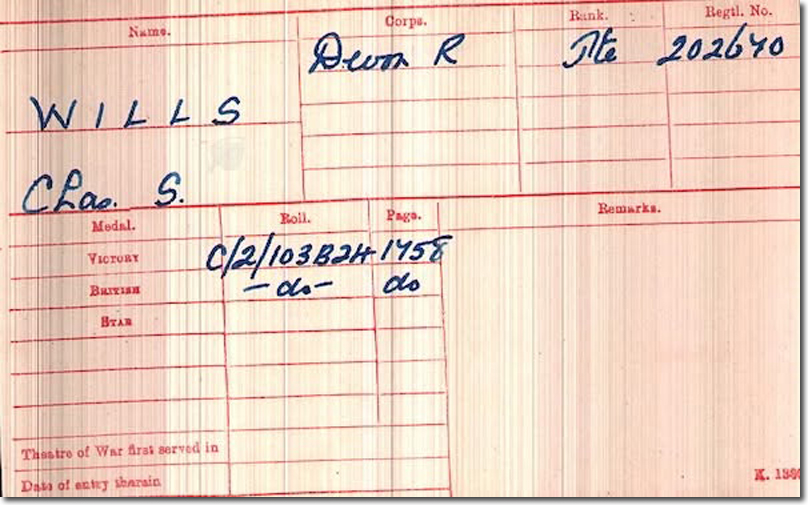
At some point during the war Charles enlisted at Plymouth as Private 202670 of the 9th (Service) Battalion, Devonshire Regiment. Unlike some of the war memorial casualties who served overseas for years before becoming casualties, there is little surviving detail about Charles's military service. His Medal Index Card records only his entitlement to the British War and Victory Medals, suggesting he first entered a theatre of war after the qualification period for the 1914 or 1914-15 Stars had passed. Whatever the details of his service, by the autumn of 1917 he found himself serving with the 9th Devons in Belgium during the closing stages of the Third Battle of Ypres.
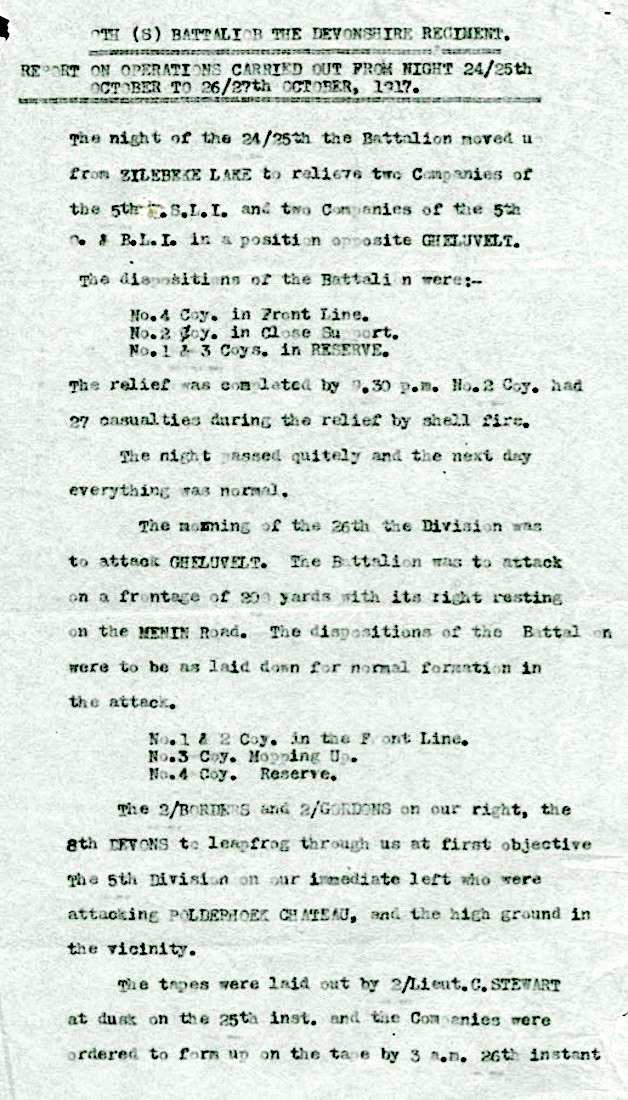
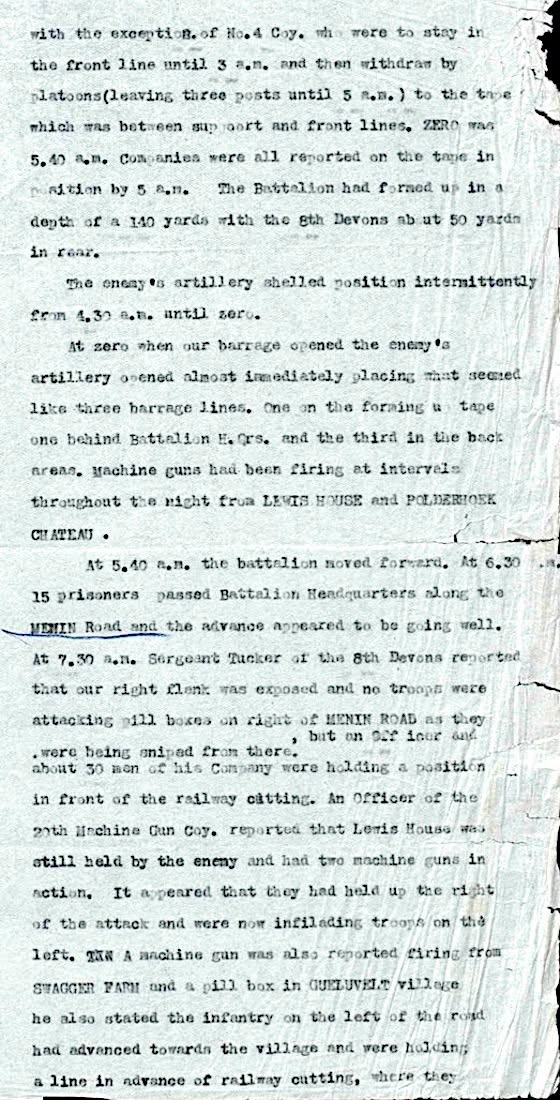
On 26 October 1917 the battalion took part in what would become one of the darkest days in its history. The 9th Devons were tasked with attacking the heavily fortified ruins of Gheluvelt immediately north of the Menin Road. The attack formed part of the wider Passchendaele campaign and was intended both to support the Canadian assault on Passchendaele Ridge and to prevent German forces being transferred from the Gheluvelt sector. The conditions could scarcely have been worse. Heavy rain had transformed the battlefield into a sea of mud that impeded every movement. The battalion's operational report records that the men formed up before dawn and advanced at 5.40 a.m. behind the barrage. Early reports suggested progress was being made, but the situation rapidly deteriorated. The battalion's right flank became exposed, machine-gun fire swept the advancing troops and the conditions underfoot proved almost insurmountable.
The official report recorded that the mud and water became so bad that rifles and Lewis guns clogged and ceased functioning unless repeatedly cleaned. Men who succeeded in reaching the village found themselves isolated, whilst German machine-guns operating from strongpoints around Gheluvelt inflicted severe casualties. The attack gradually stalled and a withdrawal to the original line became unavoidable. The regimental history later reflected upon the operation in stark terms, observing that although the battalion had suffered heavily at Loos, Mametz and Ginchy, "October 26th, 1917, stands out as the worst day the 8th and 9th Devons ever experienced." Whilst acknowledging the attack's failure, the historian concluded that the determination shown by the battalions in advancing under such impossible conditions represented "the high-water mark of their endeavour."
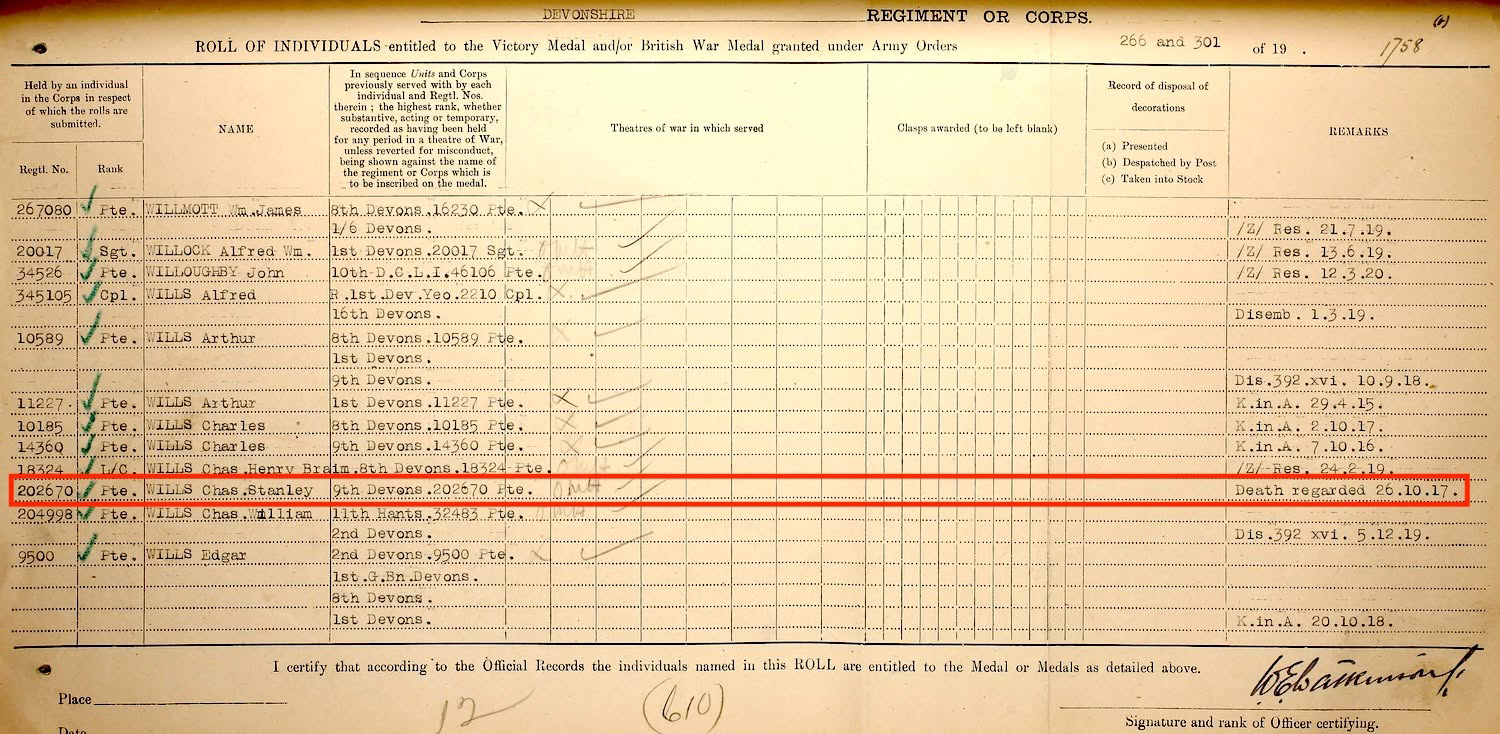
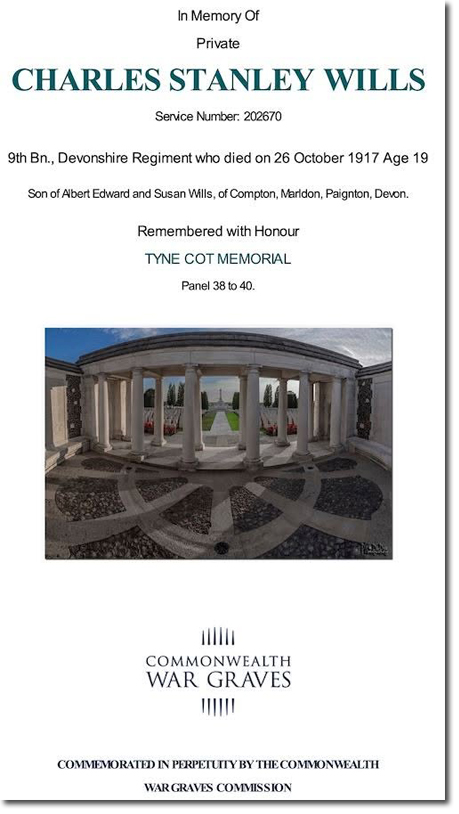
Charles was one of many casualties of that disastrous day. Initially listed as "death regarded" following the fighting, it was eventually confirmed that he had been killed on 26 October 1917 at the age of nineteen. His body was never identified and his name is therefore recorded on the great Tyne Cot Memorial, which commemorates almost 35,000 officers and men who died in the Ypres Salient after August 1917 and who have no known grave. He is also remembered on the memorials at both Marldon and Paignton.
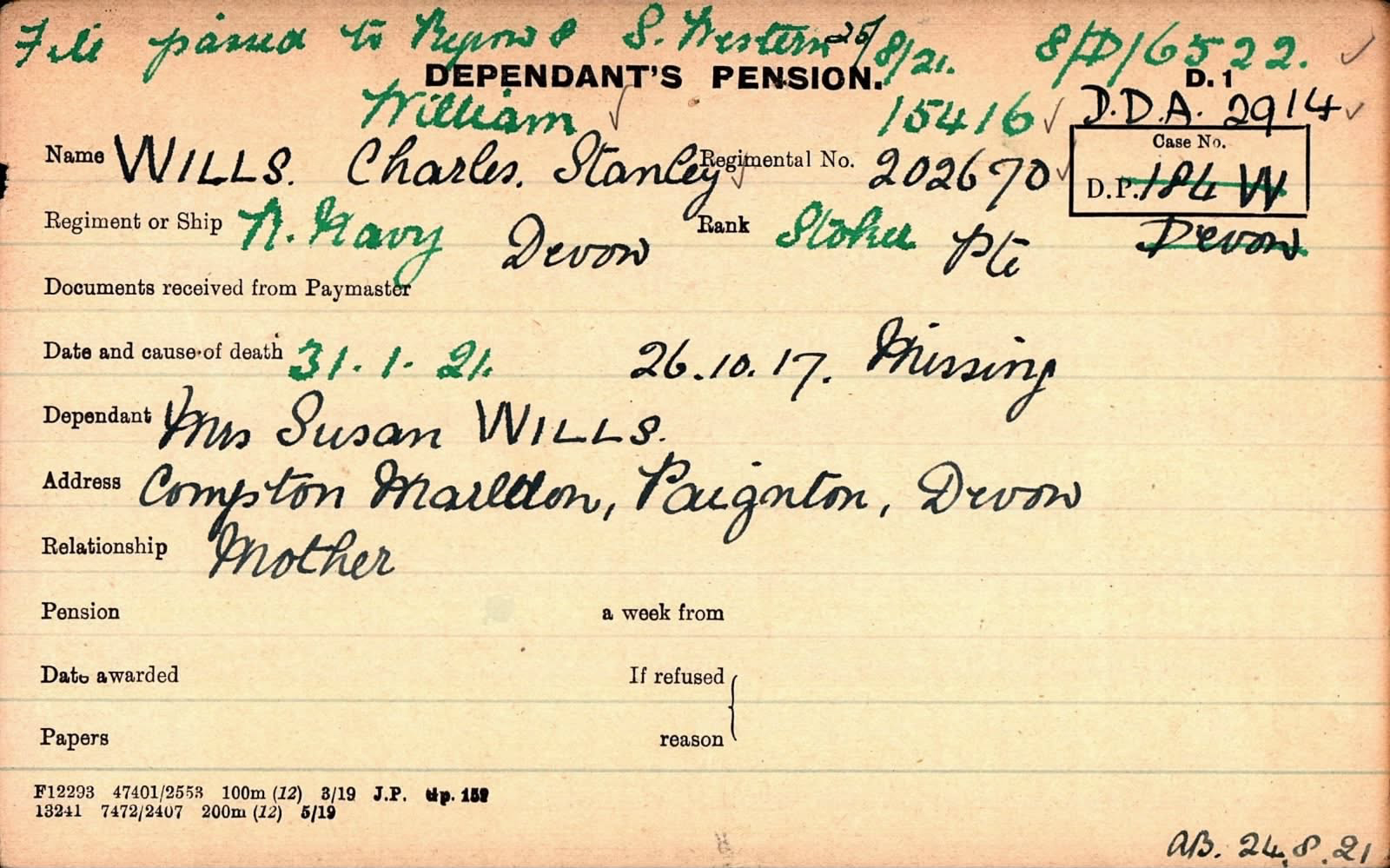
For his parents the loss was compounded by the scale of military service within the family. Charles's personal effects, amounting to £5 5s 4d, were returned to his father Albert in October 1918, whilst a war gratuity of £5 followed a year later. Pension records survive which reference both Charles and another son, William. Their mother, Susan Wills of Compton, Marldon, appears on a joint dependant's pension card for the two men.
The most unusual story within the family belongs to Charles's older brother William Wills. Born in Marldon on 14 May 1871, William had embarked upon a naval career decades before the outbreak of the Great War. He enlisted in the Royal Navy in November 1892 and served for more than twenty-five years aboard numerous vessels, eventually attaining the rank of Stoker First Class. During the war he served through HMS Vivid, the Royal Navy establishment at Devonport which acted as a barracks, training establishment and administrative depot. As a stoker he would have been responsible for the operation and maintenance of the boilers and machinery that powered Britain's steam-powered warships.
Yet William's story took a tragic turn after the war. Following his discharge from naval service in August 1919, records show that he was admitted to the Royal Naval Hospital at Great Yarmouth, which included facilities for the treatment of naval psychiatric patients. His service record described him as a "Dangerous Lunatic". He remained there until his death on 31 January 1921 at the age of forty-nine. Curiously, his death certificate appears to have understated his age by more than a decade, recording him as thirty-six. Whether this was an administrative error or arose from some other circumstance remains unclear. His inclusion on the same dependant's pension record as Charles suggests that the family regarded his death as part of the wider sacrifice made by the Wills family during and after the war years.
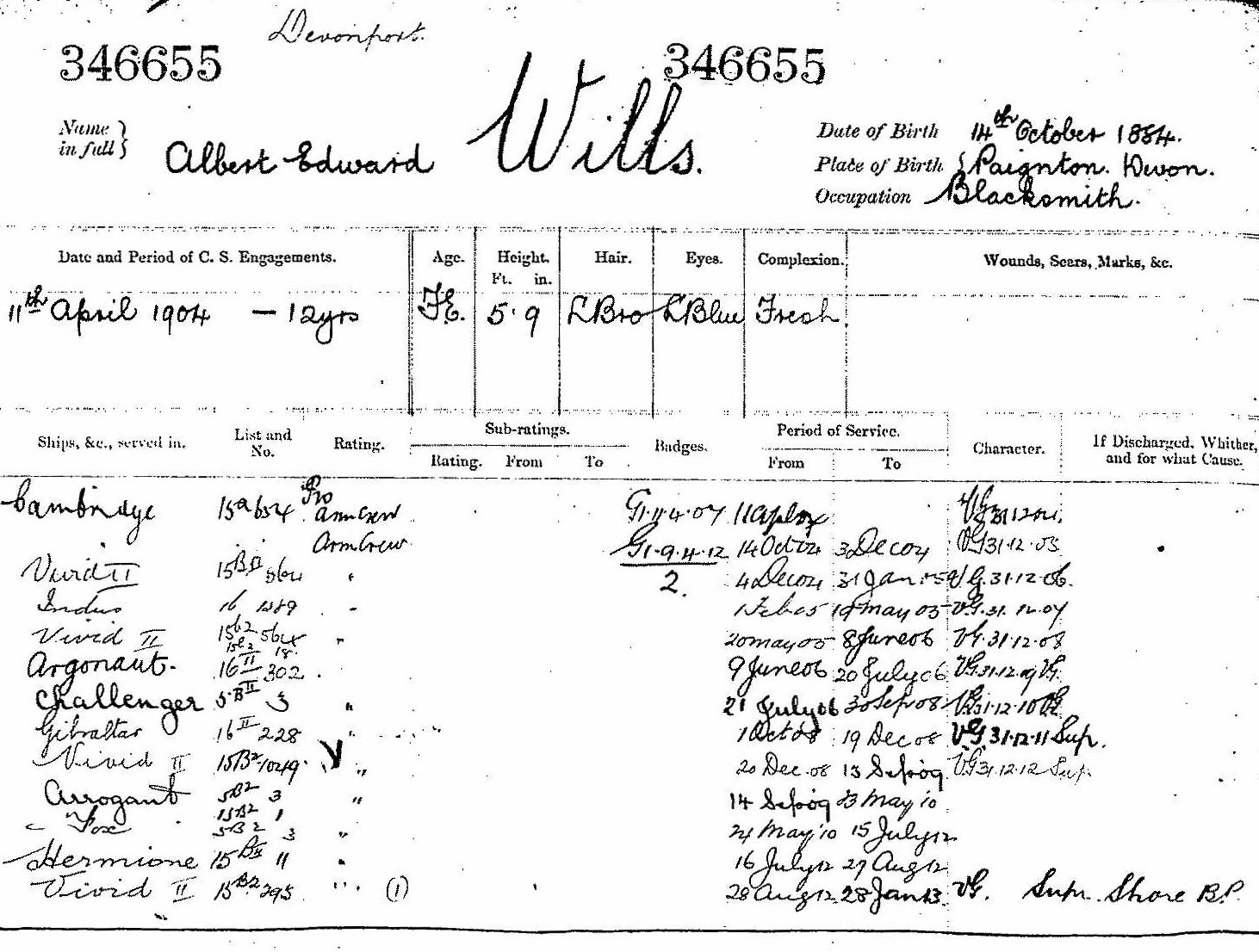
Other members of the family enjoyed more fortunate futures. Brother Albert Edward Wills, born in Marldon in 1884, served in the Royal Navy as an Armourer's Crewman before later joining the Metropolitan Police. He married Florence Louisa Lean in London in 1923 and eventually retired to Totnes, where he died in 1941. Arthur Wills, born in Marldon in 1893, joined the Royal Marine Light Infantry in 1911 and served throughout the war before returning to civilian life, marrying Gladys Helena Eva White in 1923 and eventually settling back in the Marldon area. Another brother, James "Jim" Wills, emigrated to Australia before the war and served with the Australian Imperial Force's 3rd Tunnelling Company, returning to Australia after his demobilisation in 1919.
The military records reduce Charles Stanley Wills to a single line on a memorial and an entry in a casualty list. The wider story of the Wills family is considerably richer. Between them the brothers served in the Devonshire Regiment, Royal Navy, Royal Marines, Metropolitan Police and Australian Imperial Force. Charles was killed in the mud of Passchendaele at nineteen, whilst William survived a lifetime of naval service only to die in a naval hospital less than two years after the war had ended. At the same time, other brothers survived to rebuild their lives in England and Australia. Few Marldon families contributed service on such a scale or experienced such varied fortunes during the years of the Great War and its aftermath.
With thanks to Peter Roeschlin and the WW1 Devonshire Regiment- Forgotten Soldiers Facebook Group.