

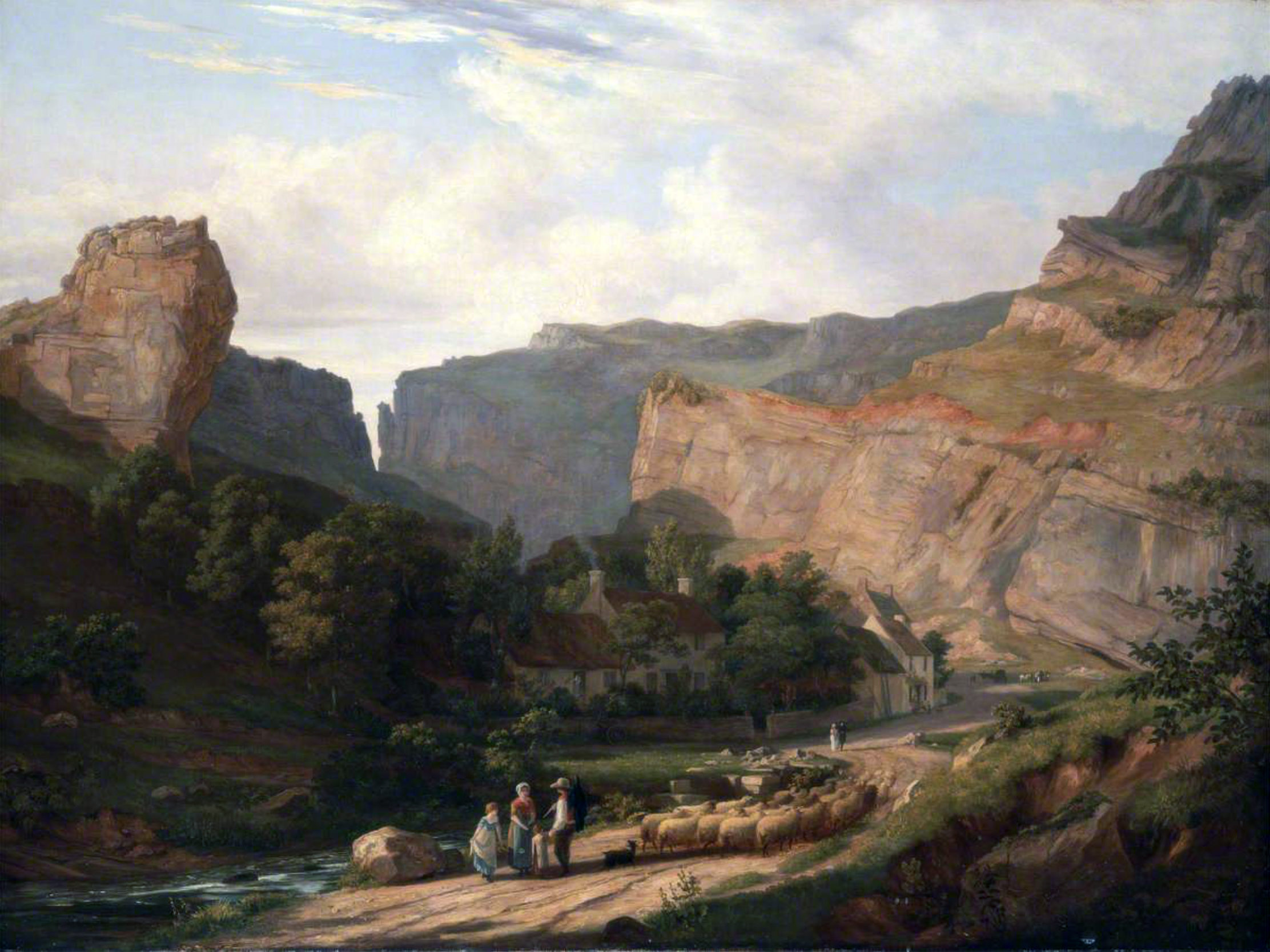
Cheddar Gorge has been a recurring subject for artists since the eighteenth century, when its steep limestone cliffs and narrow valley became recognised features within the developing taste for the picturesque. The combination of height, shadow and broken geological forms made it a natural choice for topographical sketchers and engravers whose work circulated in travel guides and county histories.
During the nineteenth century the gorge also fitted neatly into the wider Romantic interest in rugged natural scenery. Artists sought out landscapes that conveyed scale, irregularity and dramatic contrast, and Cheddar Gorge met these requirements closely. The emphasis on towering rock faces and confined space aligned with the Romantic preference for visually striking terrain rather than pastoral subjects.
One of the most notable painted views is A View of Cheddar Gorge by George Vincent (1796–1831), now in the Yale Center for British Art. Although Vincent was associated with the Norwich School, his treatment of the gorge reflects the Romantic approach to landscape: steep vertical cliffs, a narrow valley floor and a composition built around geological mass rather than human activity. The painting is reproduced on Art UK and can be viewed at:
A View of Cheddar Gorge – George Vincent.
Other nineteenth‑century artists produced watercolours and engravings of the gorge, often selecting the same viewpoints used by travellers and guidebook illustrators. These works typically emphasised the height of the cliffs and the narrowness of the approach road, features that remained largely unchanged throughout the century. The consistency of these viewpoints shows how strongly the topography lends itself to repeated artistic treatment.
By the early twentieth century Cheddar Gorge had become a standard subject for postcard publishers and commercial illustrators. Although these later images were more stylised, they continued the long tradition of depicting the gorge as one of the most distinctive natural features in the West Country. Together, the paintings, engravings and printed views form a continuous record of how artists have interpreted the gorge across more than two centuries.

