

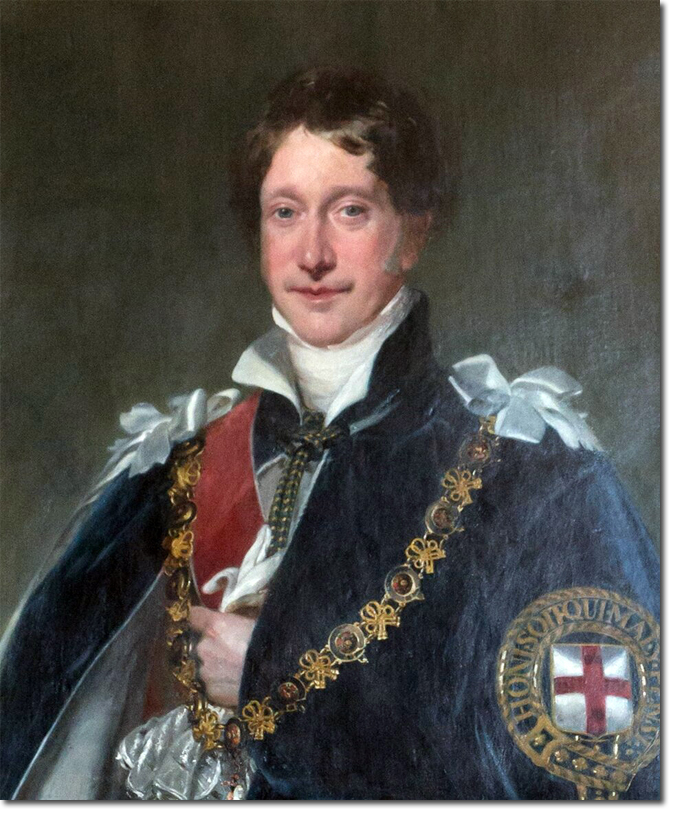
Edward St Maur (1775–1855), known as Lord Seymour, was the eldest son of Webb Seymour, 10th Duke of Somerset. He managed the family’s Devon interests and became responsible for the Stover estate, its industrial workings and its transport links. His role was administrative rather than developmental, and the estate’s infrastructure reflected that approach.
Stover House had been built in the eighteenth century by James Templer, whose family developed the ball‑clay industry in the Bovey Basin. Seymour acquired the estate in 1829. The Stover Canal, constructed in the 1790s to move clay to the Teign estuary, continued in use but gradually fell into disrepair. The Haytor Granite Tramway, completed in the 1820s, linked the Haytor quarries with the canal basin at Ventiford. Although the tramway carried granite used in major nineteenth‑century building projects, it was already cumbersome technology by the time Seymour inherited it. Three successive generations of the Seymour or St Maur family lived at Stover, but none made significant improvements to the estate or its industrial systems.
The most prominent of these was Edward Adolphus St Maur (1804–1885), who became 11th Duke of Somerset. His son, Archibald Henry Algernon St Maur (1810–1891), the 12th Duke, settled at Stover House and took an active role in Devon public life. He served as First Lord of the Admiralty, MP for Okehampton and Totnes, and later as Lord Lieutenant of Devon. He was appointed a Knight of the Garter in 1862 and created Earl St Maur of Berry Pomeroy in 1863. The family used the spelling “St Maur” during this period, although after 1923 the standard form reverted to “Seymour”.
The 12th Duke’s private life was less orderly. In 1830 he married a woman whom his brother described as a “low‑bred greedy beggar woman”. He also fathered two illegitimate children with Rosina Elizabeth Swan: a son, Richard Harold St Maur, and a daughter, Ruth Mary St Maur. In the 1920s Harold St Maur attempted to prove that his parents had been legally married at the time of his birth and that he was therefore entitled to inherit the title and property. Both actions failed. The dukedom passed instead to his younger legitimate brother, Edward Archibald Seymour, who became the 13th Duke of Somerset. The title “Earl St Maur” lapsed.
After the Great War, Harold St Maur left Stover for Kenya, where he died in 1927. His heirs leased Stover House and part of the grounds to Stover School in 1932. In 1979 Devon County Council purchased the remainder of the estate for use as a country park. The school remains on the site and is now co‑educational. The canal, the tramway remains and the estate landscape survive as evidence of the industrial system inherited by Lord Seymour and utilised by him and his successors.

