The Westaway family suffered more than most from the First World War. George Westaway, a mason's labourer from Torquay, and his wife Eliza Louisa Wheaton of Exeter raised a family of twelve children over a span of thirty-two years, though one child had already died by 1911. By the end of the war they had seen four sons serve in the armed forces whilst two never returned. Ernest Albert Edward Westaway's death in October 1918 came only six months after the loss of his younger brother Stanley, whilst Ernest's own four-year-old daughter would die only weeks later. The story of Ernest therefore forms part of a wider story of military service, bereavement and survival that affected the whole Westaway family.
Ernest was born in Marldon in 1887 and baptised there on 7 February 1889. The 1891 Census records him living with his parents and siblings in the parish, whilst by 1901 the thirteen-year-old Ernest was already working as a cattle boy. Like many boys from rural Devon, he entered employment at an early age. On 22 January 1910 he married Lilian "Lily" Crocker, who had been born in Newton Abbot in 1885, at St Mary's Church, Upton, Torquay. The couple were living at The Rookery, Marldon, by the time of the 1911 Census when Ernest was employed as a general labourer. Together they would have three children.
Before military service Ernest worked for The Devon Rosery and Fruit Farm Ltd. at Torquay. His surviving service papers provide an unusually useful glimpse of his civilian life. Whilst still in the Army Reserve, his employers supplied a written reference dated 25 November 1916 praising his standards of work as both a horseman and ploughman and recording that he had worked for them since 1906. Such references suggest he was a trusted and valued employee long before military service interrupted his working life.
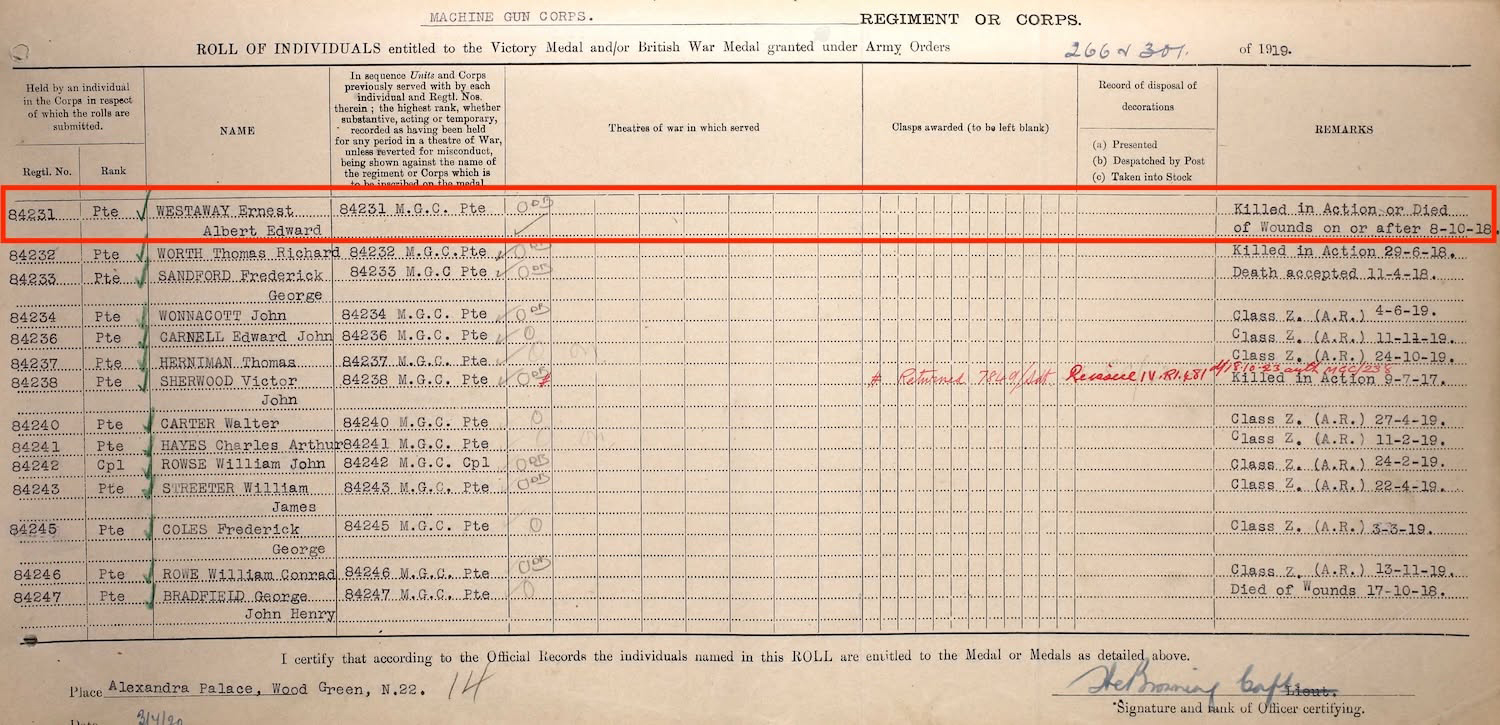
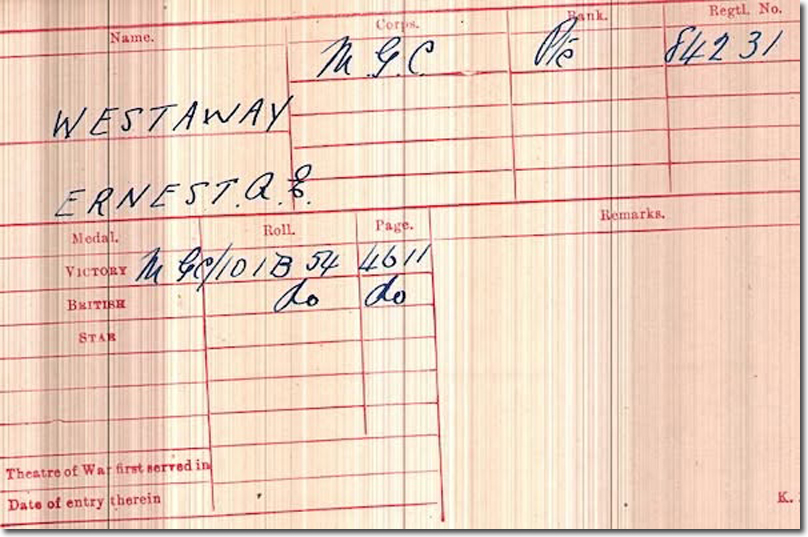
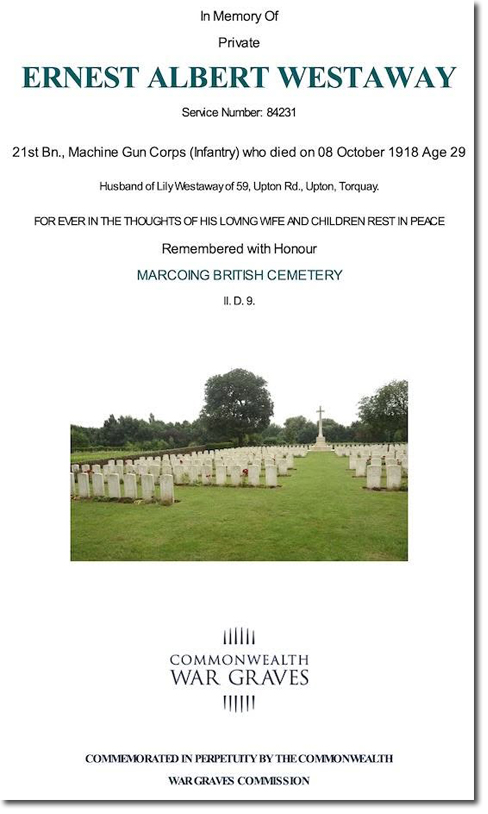
Ernest appears to have enlisted at Torquay on 30 November 1915 as Private 46814 of the 3rd (Reserve) Battalion, Devonshire Regiment. He was mobilised through the Devonshire Regiment Depot at Exeter before transferring on 3 February 1917 to the Machine Gun Corps (Infantry), receiving the new service number 84231. He served as a transport driver and embarked for France with No. 176 Draft on 27 August 1917. Although some parts of his service record are difficult to read, it appears that he joined the 21st Battalion, Machine Gun Corps during September 1917.
By the final year of the war the Machine Gun Corps had become an essential element of British battlefield tactics. Machine-gun battalions concentrated firepower on a scale previously impossible and played a major role in both defensive operations and the Allied offensives of 1918. As a transport driver Ernest occupied a vital supporting role, responsible for helping move men, guns, ammunition and supplies wherever they were needed. It was work that frequently brought men into dangerous forward areas and exposed them to the same artillery fire and battlefield hazards faced by infantry units.
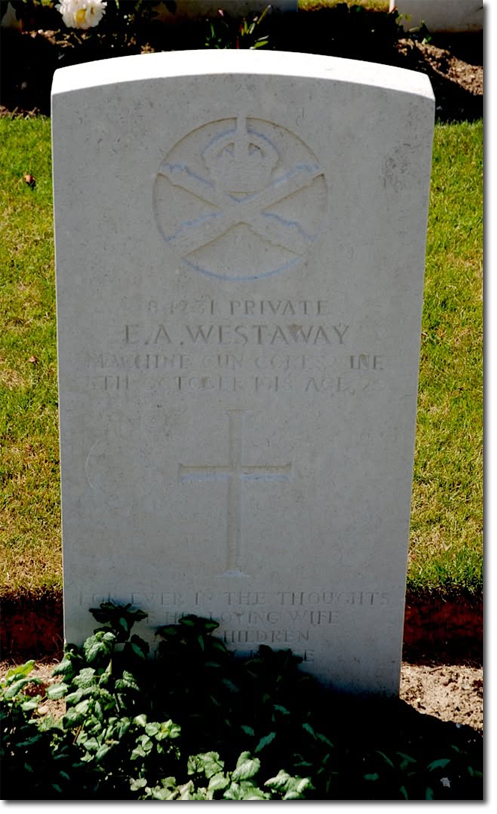
During the Hundred Days Offensive of 1918, the campaign that finally forced the German Army into retreat, Ernest's battalion took part in the relentless Allied advance across northern France. On 8 October 1918 he was reported as missing and wounded, though it was soon established that he had been killed in action, or had died from wounds received that day, at the age of thirty-one. Unlike many of those killed during the advance, his body was recovered. Following the war his remains were exhumed from a battlefield grave marked by a cross and reburied in March 1920 at Marcoing British Cemetery. Today he rests there amongst many of the casualties of the final weeks of the war. He is commemorated on the Marldon Memorial Brass and also on the Torquay War Memorial.
For Lily Westaway the consequences were immediate and severe. She was left a widow with three children and received an £8 grant in January 1919 to assist with the immediate financial hardship caused by her husband's death. From June 1919 she was awarded a weekly pension of twenty-five shillings, which was progressively reduced as the children reached the age of sixteen. Ernest's personal effects, including a war gratuity, totalled £18 3s 2d and were paid to Lily on 22 April 1919. His British War and Victory Medals were subsequently issued to her in May 1922. Yet the family's difficulties did not end with Ernest's death. On 30 October 1918, less than a month after Ernest was killed and only days before the Armistice, the couple's four-year-old daughter Winifred Gladys Westaway died from acute bronchitis.
The tragedy formed part of an even wider sequence of losses for the family. Ernest's younger brother Stanley James Isaiah Westaway, born in Marldon on 2 March 1898, had enlisted in the Royal Navy on 10 April 1916 and served as a Stoker 1st Class. He died from pneumonia on 8 April 1918 at just nineteen years of age and was buried in Marldon churchyard. Their mother Eliza Louisa Westaway survived the deaths of both sons but died in 1919 at the age of sixty-one. The following year George Westaway remarried, marrying the widow Mary Elizabeth Perrow at Marldon on 19 June 1920.
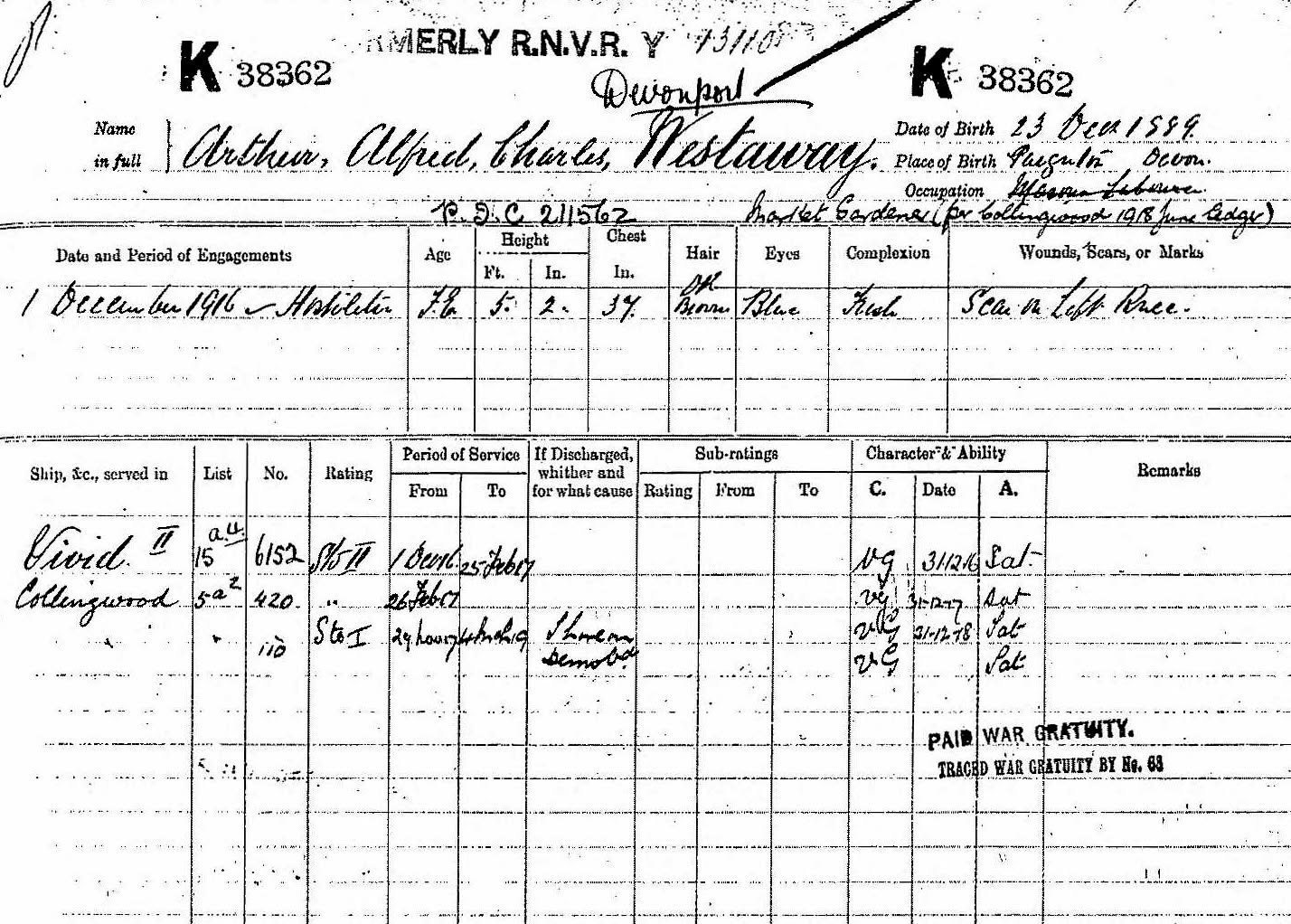
Not all of the family's servicemen shared Ernest and Stanley's fate. Brother Arthur Alfred Charles Westaway, born at Paignton on 23 December 1889, served in the Royal Navy as Stoker K38362 between December 1916 and March 1919, serving at HMS Vivid and HMS Collingwood. Before that he appears to have served in the Royal Naval Volunteer Reserve. He married Ettie Pidgeon, eight years his senior, in 1915 and by 1921 was living at 2 Rookery Cottages, Marldon, working as a builder's labourer. Later records place him at Furzegood Cottages, Totnes, and he died in Bideford in 1968 at the age of seventy-nine, having been predeceased by his wife in 1956.
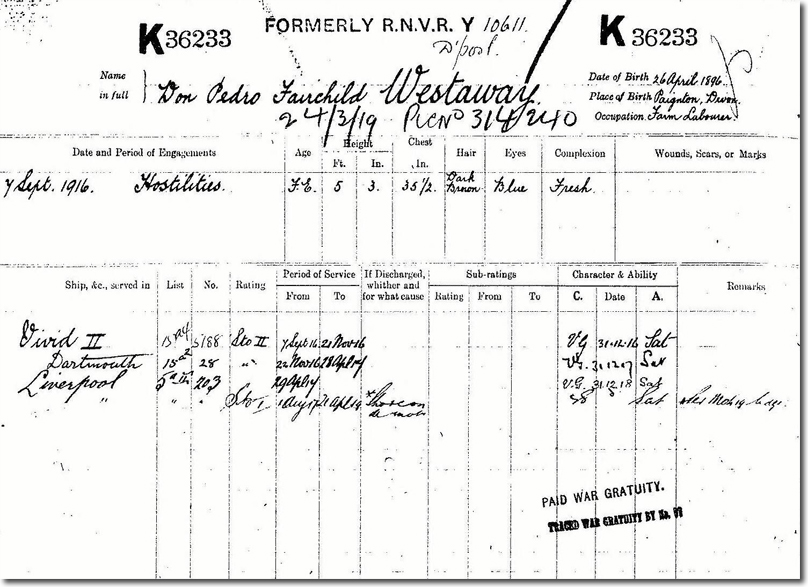
Another brother, Don Pedro Fairchild Westaway, born in Marldon on 26 April 1896, also served in the Royal Navy. Enlisting as Stoker K36233 in September 1916, he served at HMS Vivid II, Dartmouth, and aboard HMS Liverpool before his demobilisation in April 1919. He married Ida V. B. Ridgway in 1920 and by 1921 was working as a gardener whilst living with his wife at his parents' home, Fern Lea, Marldon. He died relatively young in Totnes in 1939 aged forty-three.
The official records describe Ernest Westaway simply as a private soldier of the Machine Gun Corps killed on 8 October 1918. The wider family story, however, reveals much more than a single casualty. Within a period of little more than two years the Westaways experienced military service in both Army and Navy, the deaths of Stanley and Ernest, the loss of Ernest's young daughter Winifred, the death of their mother Eliza, and George Westaway's subsequent remarriage. At the same time other brothers returned home from war, married and raised families of their own. Few Marldon families experienced so much change, loss and upheaval in so short a period of time.
With thanks to Peter Roeschlin and the WW1 Devonshire Regiment- Forgotten Soldiers Facebook Group.