St Olave’s Church on Fore Street is one of Exeter’s oldest ecclesiastical foundations. Like several of the city’s medieval churches, it originated in late Anglo‑Saxon times. Its dedication is to St Olaf (Olave), the Christianised Viking war‑lord who became king of Norway and was declared a saint soon after his death in 1030. The church is traditionally associated with Gytha, countess of Wessex, sister‑in‑law of King Cnut and mother of Harold Godwinson. She owned a considerable part of the pre‑Conquest parish and appears to have established a house‑chapel here. Later medieval tradition records that during William the Conqueror’s siege of Exeter in 1068, the priest of St Olave’s enabled Gytha to escape. After the Conquest her confiscated Exeter properties, including this church, were handed to French monks who also founded St Nicholas’ Priory in the alley behind. St Olave’s remained closely connected with the priory throughout the medieval period.
Little survives of Gytha’s original church except perhaps the small square tower built into the body of the building, visible from the street and unusually positioned within the sanctuary. A delicately carved Romanesque column base and capital are lodged in the staircase leading to the top of the former rood screen. Towards the end of the fourteenth century the church was largely rebuilt, with slender octagonal piers and a north aisle running the length of the building. This aisle provided space for an additional altar where the organ now stands. Of the decorative work from this period there remains a mutilated sculpture depicting the Scourging of Christ before King Herod, probably part of an


Gytha, Countess of Wessex

Gytha, Countess of Wessex, was one of the most influential women of the late Anglo‑Saxon period. She was the wife of Earl Godwin, mother of King Harold Godwinson, and sister‑in‑law to King Cnut. Through her marriage and family connections she occupied a central position in the political life of eleventh‑century England. Her estates were extensive, and she held significant property in Exeter and the surrounding region. The later medieval tradition that she founded St Olave’s Church on Fore Street reflects her status and presence in the city. The dedication to St Olaf, the Christianised Viking king, aligns with her Scandinavian connections through Cnut’s family.
Gytha’s influence extended across Wessex and beyond. Her children occupied major positions: Harold became king in January 1066, while her other sons held earldoms and military commands. Her daughters married into prominent families, strengthening the Godwinsons’ political network. The family’s rise was rapid, and by the mid‑eleventh century they were the most powerful dynasty in England apart from the royal house itself. Gytha’s position within this network was central, and her estates formed part of the family’s wealth and authority.
After Harold’s death at the Battle of Hastings, Gytha remained in Exeter, where she held considerable property. William the Conqueror’s siege of the city in 1068 brought her into direct conflict with the new regime. Medieval tradition records that the priest of St Olave’s enabled her to escape during the siege. Following the city’s surrender, her estates were confiscated and handed to Norman and French ecclesiastical foundations, including the monks who established St Nicholas’ Priory. This transfer marked the end of her influence in Exeter and the redistribution of her holdings to supporters of the new king.
Little is known of Gytha’s later life. Some sources suggest she may have left England after the Conquest, possibly travelling to Scandinavia or to Flanders, where members of her extended family had connections. Her death is not recorded with certainty, and her final years remain obscure. What is clear is that her family’s fortunes were irrevocably altered by the events of 1066 and the subsequent Norman consolidation of power. The Godwinsons, once dominant, were displaced, and their estates absorbed into the new feudal order.
Gytha’s legacy in Exeter survives principally through the traditions associated with St Olave’s Church and the memory of her pre‑Conquest estates. The church’s unusual dedication, its early history, and its connection with the events of 1068 all reflect her presence in the city. Although the original Anglo‑Saxon building has not survived, the later medieval structure stands on the same site, marking the location of one of the most significant ecclesiastical foundations linked to her. Her role as mother of England’s last Anglo‑Saxon king and as a major landholder in the southwest ensures her continued historical importance.


An arch was cut through the tower wall to open into the chancel, and a squint was pierced through its northeast angle so that an attendant could see the altar and ring the bell at specific points in the service. The single medieval bell still hanging in the tower bears the Latin inscription: “Voce mea viva depello cuncta noxia” – “By my lively voice I disperse all that is harmful.” Further large‑scale modifications took place in the fifteenth century when an outer north aisle was added. Its short length was probably dictated by existing buildings. Matching windows were inserted around the church, and a new doorway was provided beside the tower. This doorway is now blocked but remains visible from the street, occupied by a war memorial. The outer timber wagon‑roof, the lower struts of which rest on corbels projecting high on the north face of the tower, is concealed by later plaster ceilings.
Declared redundant during the Commonwealth period, St Olave’s was used for a time as a parish school‑room. Between 1635 and 1758 it served as a place of worship for French Protestant Huguenot refugees, several of whose names appear on the memorial floor slabs. Afterwards the church was used as a military chapel for regiments quartered in Exeter. In the early nineteenth century the south wall was dismantled and rebuilt a few feet further south, flush with the tower and abutting the street. Additional seating was installed in a wooden gallery, part of which survives above the porch. At this time the royal arms of William III, now hanging on the west wall of the vestry, formed the centrepiece of the altar, flanked by painted panels of the Lord’s Prayer and the Ten Commandments.
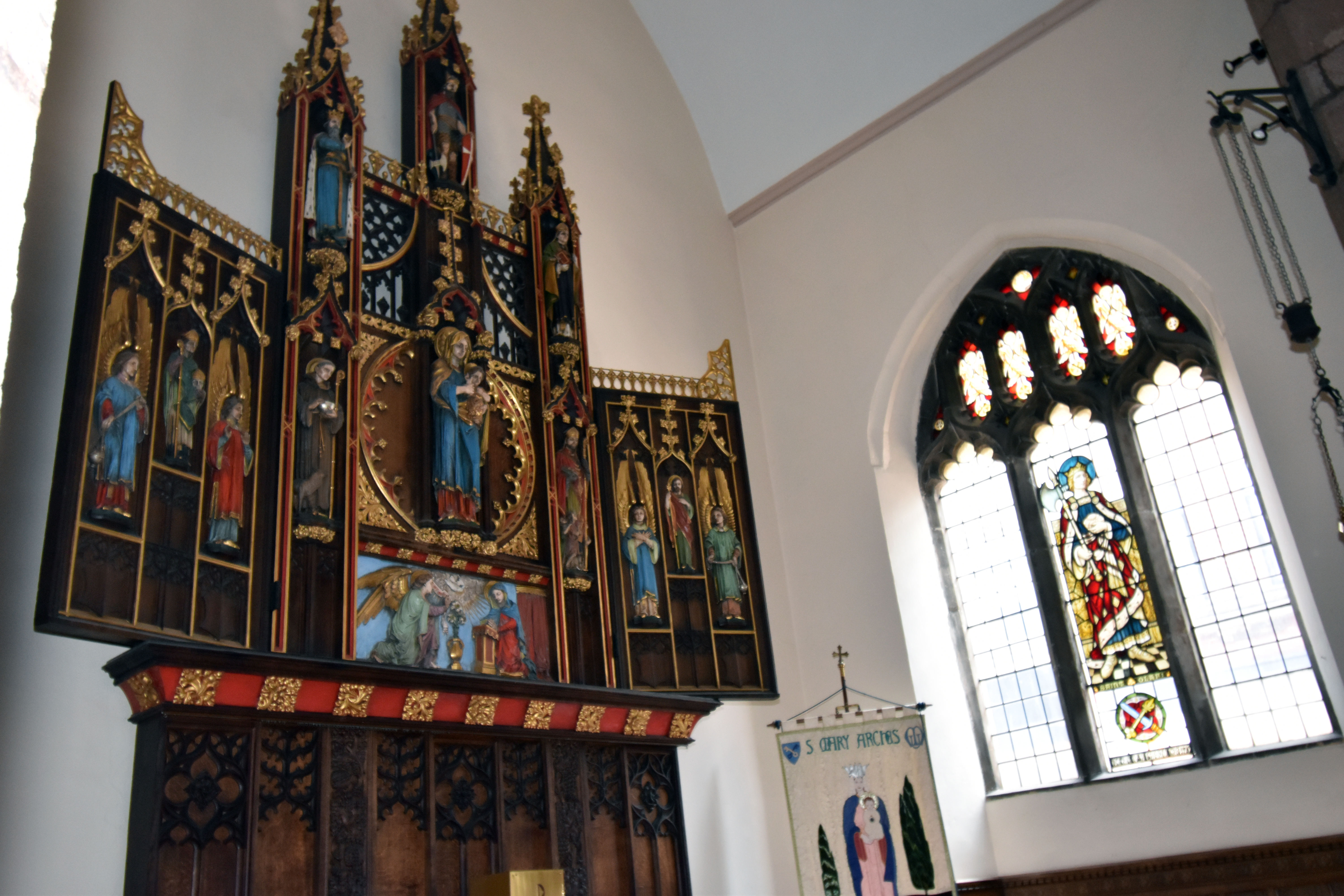
During the Victorian High Church revival St Olave’s was refurnished. New benches were made from old box‑pews, and the present font and pulpit were installed. A fine iron screen was added on the north side of the sanctuary. The wooden sanctuary screen and the altar triptych date from the early twentieth century. The reredos, begun in 1902 and probably completed in 1919, depicts the Annunciation at the base, with Mary holding the Christ Child in the centre. Above are figures associated with the church’s history: St Olaf as warrior king of Norway, St Boniface of Crediton, St Nicholas of the nearby priory, King Edward the Confessor, and St Petrock. A restored banner on the north wall of the chancel shows the Virgin and Child against a background of sea and red sandstone cliffs typical of East Devon. It is likely a mid‑twentieth‑century Mothers’ Union processional banner.
St Olaf himself was a Viking war‑lord who converted to Christianity in Normandy around 1014. He returned to Norway intending to establish himself as king and to Christianise the country. His harsh enforcement of rule and religion led to his exile after an invasion by Cnut in 1028. Olaf died in battle in 1030 attempting to regain his throne. He was buried at Nidaros (modern Trondheim), and stories of miracles soon circulated. He was canonised by Pope Alexander III in 1164. The earliest written history of Norway, composed between 1170 and 1220, calls him “Rex Perpetuus Norvegiae” – Norway’s perpetual king. His cult provided a local saint whose martial qualities aligned with accepted Viking ideals, aiding the spread of Christianity in Norway.
St Olave’s became part of the Parish of Central Exeter in 1971. The church retains its medieval fabric, later additions, and fittings accumulated over centuries of use. It stands on Fore Street beside the western approach to the city and remains a compact example of Exeter’s layered ecclesiastical history.