The name of Herbert William Elkanah Hill appears on the Marldon War Memorial, a reminder that the Great War continued to claim lives right up until its final weeks. Whilst many people associate the war's casualties with battles such as the Somme or Passchendaele, Herbert was killed during the victorious Allied advance of 1918, at a time when the German Army was retreating and the end of the conflict was finally coming into sight. It was a bitter irony repeated across Britain. Men who had survived years of trench warfare, shellfire and disease were still being killed in the closing weeks of a war that would end less than seven weeks later.
Herbert was born on 20 December 1893 and baptised at Totnes on 11 March 1894. He was the son of William Walter Hill, a gardener originally from Harberton, and Jane Caseby Tucker of Buckfastleigh. He grew up in a large family, one of eight children born over an eighteen-year period. The 1901 Census finds him living with his parents and siblings at 19 South Street, Totnes, where seven-year-old Herbert was growing up in a household supported by his father's work as a domestic gardener. By 1911 the family had moved to Shinners Bridge, Dartington, and Herbert, aged seventeen, was following a similar path, working as a domestic under gardener. His future must have appeared settled. Like countless young men across rural Devon, his life revolved around family, work and the communities of the South Hams.
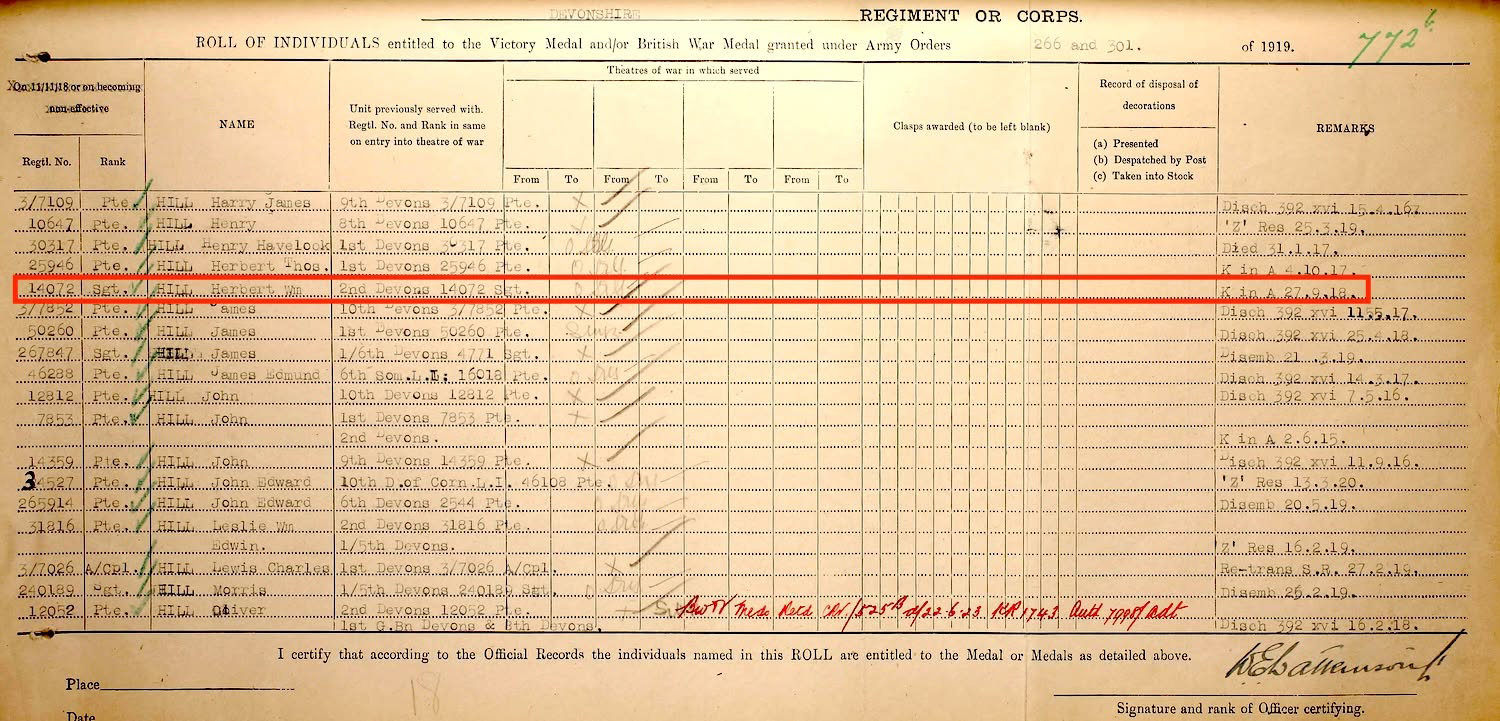
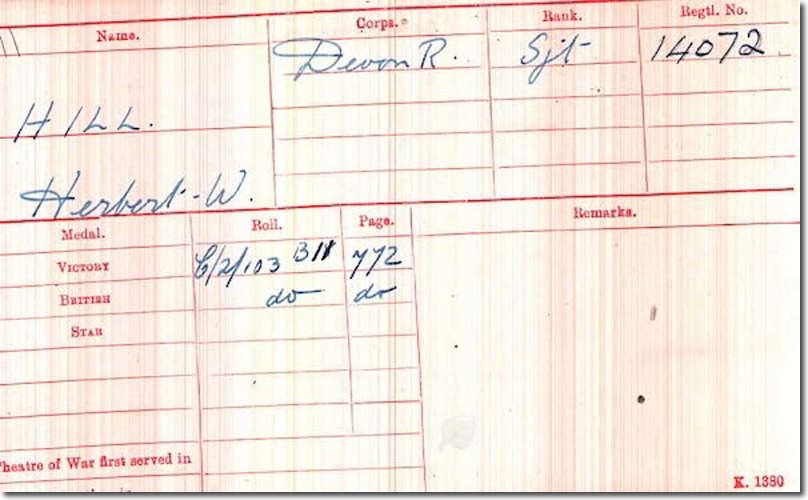
Everything changed with the outbreak of war in August 1914. Herbert enlisted at Totnes on 26 October 1914, receiving the service number 14072 in the Devonshire Regiment. Unlike many of the men whose names appear on war memorials, he did not serve for a few months before becoming a casualty. Instead, he spent almost four years in uniform. During that time he rose to the rank of Sergeant in the 2nd Battalion, Devonshire Regiment, a position requiring both experience and leadership. By 1918 he was no longer one of Kitchener's eager volunteers but a seasoned non-commissioned officer who had survived some of the hardest years of the war.
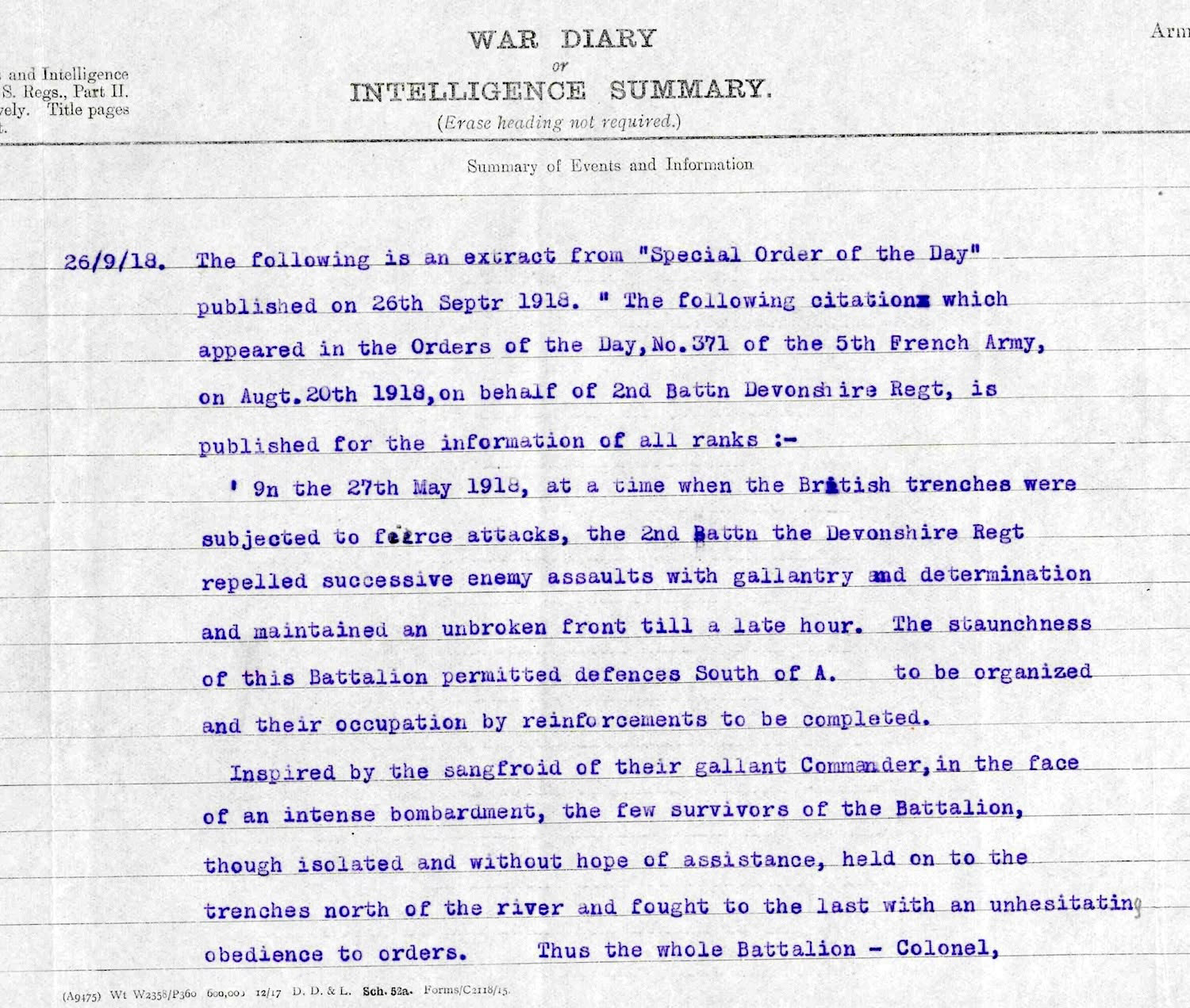
The battalion with which Herbert served developed a formidable reputation. Earlier in 1918 the 2nd Devons had played a distinguished role during the German Spring Offensive. A citation reproduced in the battalion war diary praised the battalion's conduct under fierce attack, recording how the survivors had maintained an unbroken front despite intense bombardment and repeated assaults. Inspired, it noted, by the example of their commanding officer, the men fought on despite being isolated and without immediate hope of assistance. By the autumn of 1918, however, the strategic situation had changed dramatically. The German offensives had failed and the Allies had seized the initiative. The task now was to drive the enemy back towards the frontier.
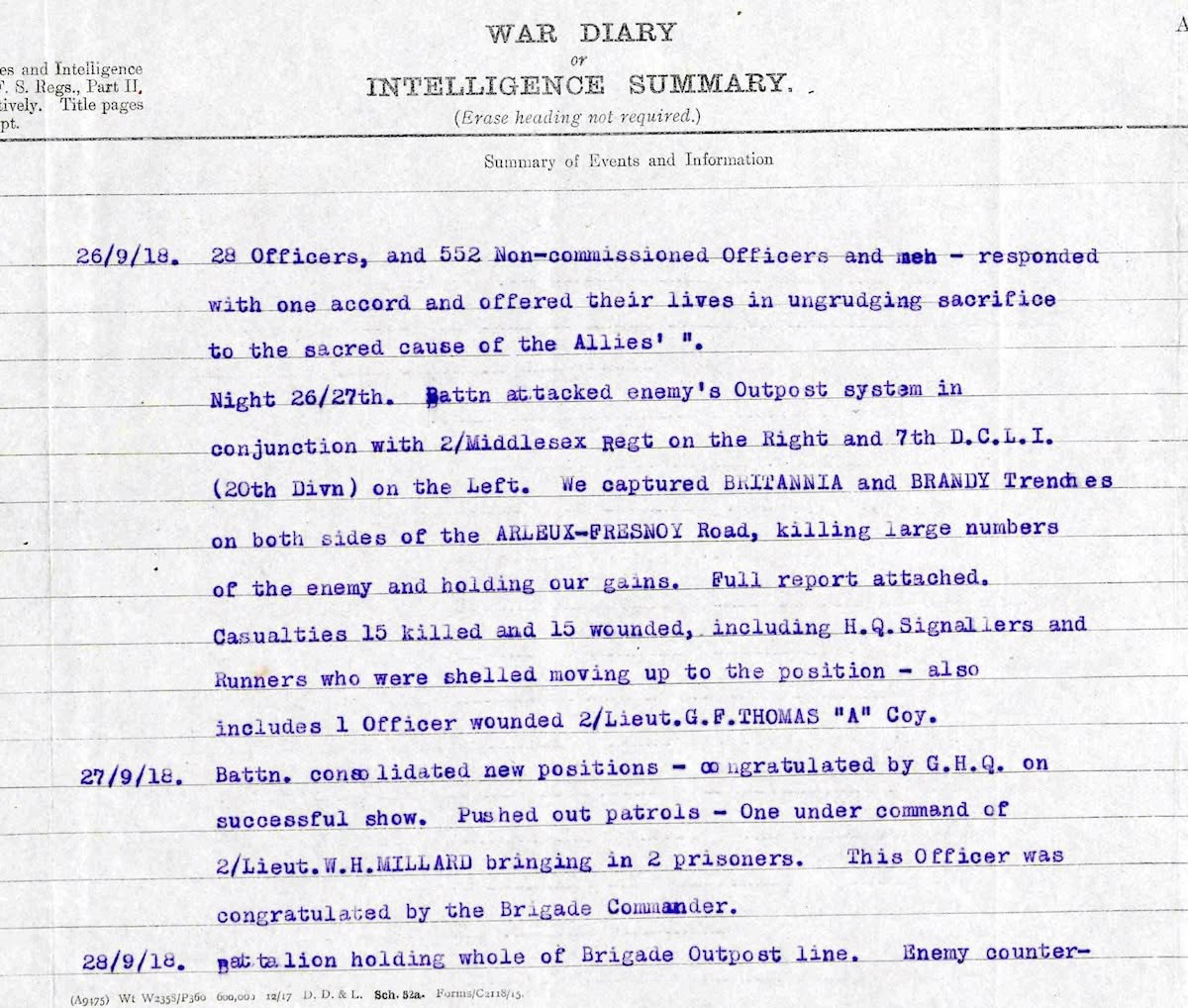
During September 1918 the 2nd Devons formed part of the great Hundred Days Offensive, the campaign that finally broke German resistance on the Western Front. Fighting remained fierce despite the increasingly obvious prospect of Allied victory. On the night of 26-27 September 1918, the battalion attacked enemy outpost positions alongside neighbouring units. The battalion war diary recorded the capture of the enemy positions known as Britannia and Brandy Trenches on either side of the Arleux-Fresnoy Road. The attack succeeded in its objectives, large numbers of German defenders were killed and the captured ground was retained. Headquarters later congratulated the battalion on its success. Yet victory came at a cost. The same diary recorded fifteen men killed and fifteen wounded during the operation.
It was during this fighting that Sergeant Herbert William Elkanah Hill was killed in action on 27 September 1918 at the age of twenty-four. Precisely how he died is unknown, but his death occurred at the height of an operation that his battalion considered successful. Like many casualties of the final advance, he has no known grave. Today his name is commemorated on the Vis-en-Artois Memorial in France, which records thousands of servicemen who died during the later stages of the war and whose resting places remain unknown. Closer to home he is remembered on the Marldon War Memorial.
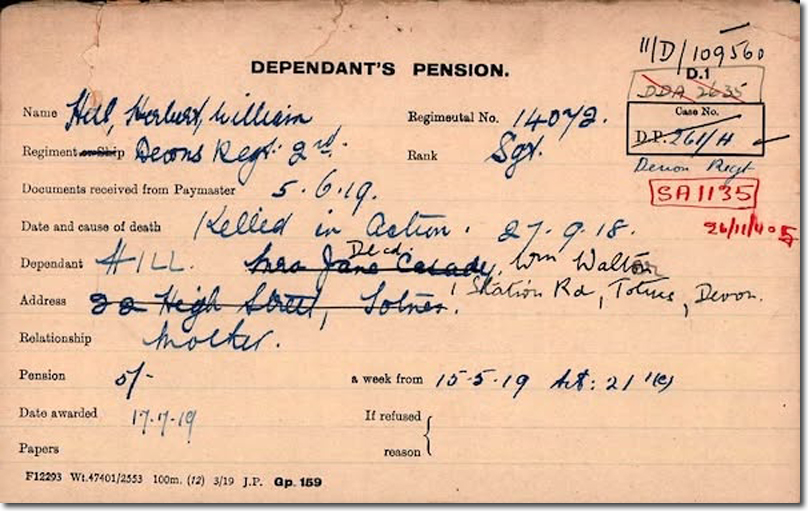
For Herbert's family the war did not end on 11 November 1918. Army records preserve glimpses of the loss that followed. His personal effects, amounting to £7 15s 3d, were returned to his father in March 1919. Later that year a war gratuity of £22 was paid, reflecting the length of his service. Herbert's mother, Jane, received a dependant's pension of five shillings per week from May 1919. Following her death in 1940 the pension passed to her husband. Such entries in official records may seem routine today, but they represent the administrative aftermath of a family tragedy repeated across thousands of British households.
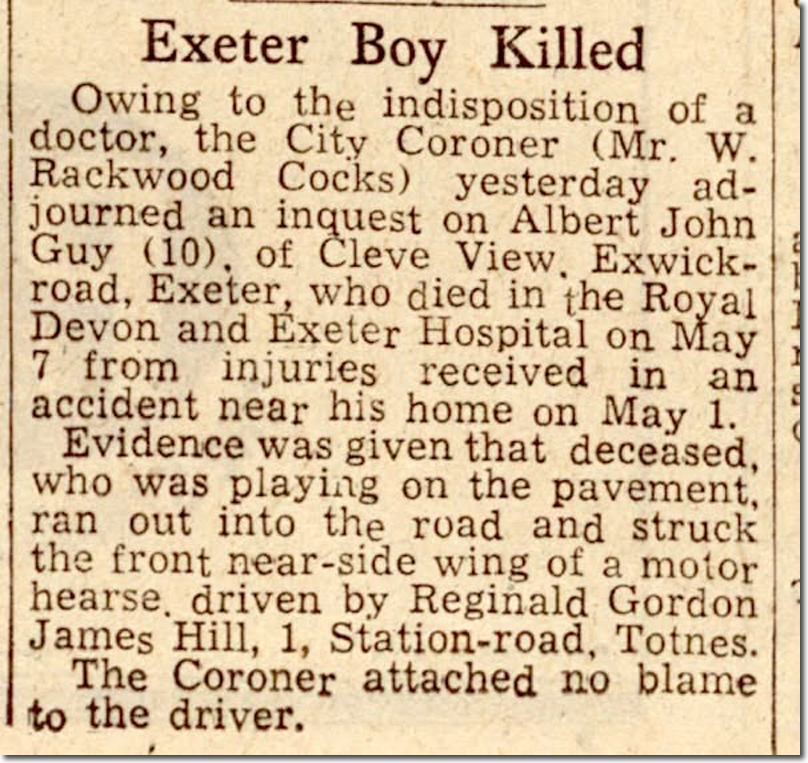
The Hill family contributed more than one son to the war effort. Herbert's younger brother, Reginald Gordon James Hill, born in Paignton in 1897, worked as a motor mechanic before enlisting in the Army Service Corps on 10 December 1915. Whilst Herbert served in the trenches of the Western Front, Reginald's war followed a very different course. After training and home service he embarked for Mesopotamia in March 1917, serving with 962 Motor Transport Company. The maintenance and operation of military transport was vital to Britain's campaigns in the Middle East where vast distances, extreme temperatures and poor roads placed enormous demands upon men and machines alike. Reginald rose through the ranks to become Acting Corporal in January 1919 and later Sergeant before transferring to the 'Z' Reserve at the end of that year. Returning home, he married Beatrice E. Birch in Totnes in 1925 and lived the life that his older brother never had the opportunity to enjoy. Yet even the survivors carried burdens of their own. In May 1943 Reginald was involved in a tragic road accident in Exeter when a ten-year-old boy ran into the path of the motor hearse he was driving. The child later died of his injuries, though the inquest attached no blame to Reginald. He eventually died in Totnes in 1967, having survived both war and tragedy to live almost half a century beyond the conflict that claimed his brother's life.
Herbert Hill had enlisted during the first months of the war and served long enough to witness its final act. He survived the battles of the middle years and the desperate German offensives of 1918 only to lose his life during the victorious advance that brought the conflict to an end. His name on the Marldon War Memorial stands as a reminder that even in victory the cost of war continued to be paid, and that for families such as the Hills the celebrations of November 1918 could never fully erase the losses that had come before.
With thanks to Peter Roeschlin and the WW1 Devonshire Regiment- Forgotten Soldiers Facebook Group.