

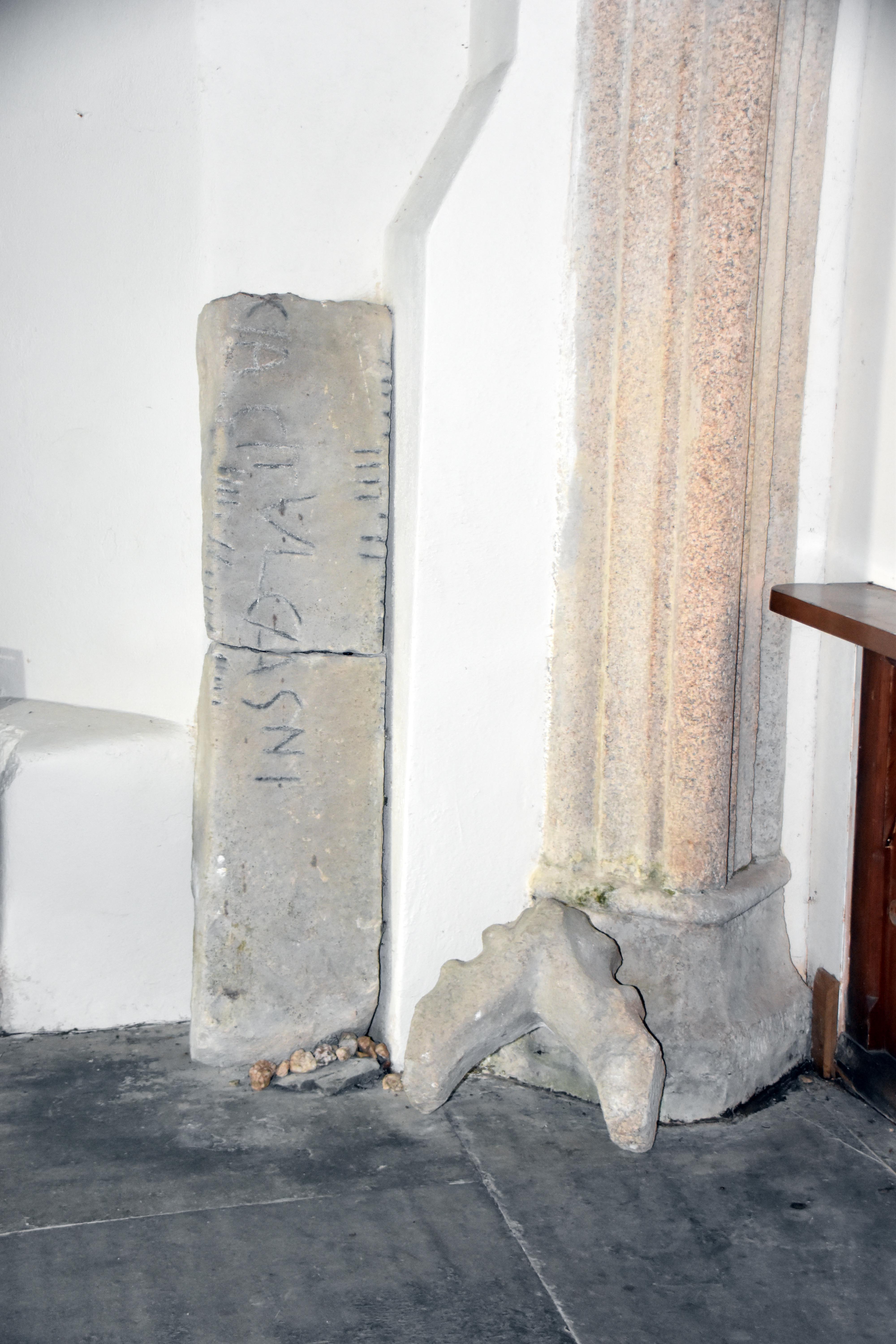
Lewannick is unusual among Cornish parishes in preserving more than one early medieval inscribed stone. The best known is the interior Ogham stone now standing inside St Martin’s Church, close to the base of a granite column. It carries a Latin inscription on its face and an Ogham inscription cut along the edge, linking the Latin and Irish traditions of writing in the post‑Roman period. The stone is generally dated to the fifth or sixth century and belongs to the group of Christian memorial stones erected for local elites in the early Cornish church.
The Latin text on the Lewannick stone records the name of the commemorated individual, while the Ogham script repeats or adapts that name in the Irish fashion. Ogham consists of groups of strokes cut along an arris or edge, read from bottom to top. Its presence at Lewannick shows that the community which set up the stone was in contact with Irish or Irish‑influenced clergy and scribes, and that the early church in this part of Cornwall was part of a wider Atlantic Christian culture rather than an isolated outpost.
A second Ogham stone from Lewannick, now kept at a distance from the church, adds to this picture of an early Christian landscape marked by inscribed pillars. Together the stones indicate that the area around Lewannick was a focus of settlement and religious activity in the centuries after the end of Roman rule. They also show that commemoration of the dead was carried out in a formal, literate way, using both Latin and Ogham to fix names and status in stone.
The later history of the Lewannick Ogham stones reflects changing attitudes to the early medieval past. For much of the post‑medieval period they were treated simply as old stones, reused or left in situ without particular care. Only in the nineteenth and twentieth centuries were they recognised as important documents of the early Cornish church and moved or protected accordingly. The interior stone’s present position within St Martin’s, beside the rebuilt fabric of the church, sets an early Christian monument within a Victorian and later context.
For visitors today, the Lewannick Ogham stones offer a direct, material link to the first centuries of Christianity in Cornwall. They stand alongside later memorials to the Archer family and others, showing how the parish’s story runs from the age of inscribed pillars through medieval rebuilding and nineteenth‑ century restoration to twentieth‑century war memorials. In that sequence the Ogham stones are the oldest surviving witnesses, marking Lewannick as a place where language, faith and local identity were carved into stone more than a millennium ago.

