

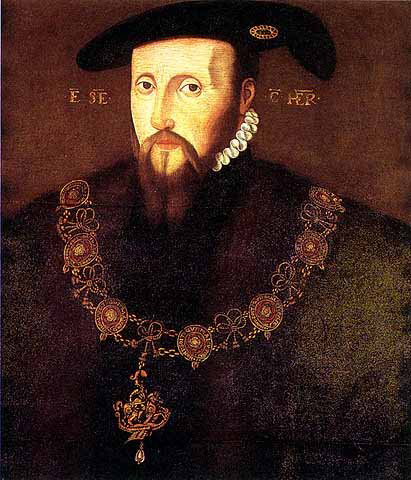
Edward Seymour’s connection to Berry Pomeroy began in 1547 when, as Lord Protector to the young Edward VI, he acquired the Pomeroy estate. The Pomeroys, weakened by debt and political misfortune, sold their ancestral seat at a moment when Seymour’s authority was at its height. The purchase formed part of his wider consolidation of Westcountry lands intended to reinforce his position during the early years of the new reign. Berry Pomeroy Castle therefore became one of the properties symbolising his brief ascendancy.
Seymour’s architectural intentions at Berry Pomeroy were domestic rather than military. The late medieval gatehouse built by the Pomeroys remained intact, but Seymour’s additions to the east of it were designed as a comfortable Tudor mansion. The large mullioned windows, symmetrical façades and internal planning reflect the conventions of mid‑sixteenth‑century gentry houses. The masonry is lighter than that of the gatehouse, and the fenestration broader, indicating a residence conceived for peace rather than defence. The contrast between the fortified core and Seymour’s domestic wing illustrates the rapid decline of military architecture after the end of the Wars of the Roses.
Seymour’s policies as Protector had direct consequences for the region surrounding Berry Pomeroy. His acceleration of Protestant reform, including the introduction of the English prayer book, provoked widespread unrest in Devon and Cornwall. The 1549 Prayer Book Rebellion was the most serious internal challenge of Edward VI’s reign. The rebels’ demands for the restoration of traditional liturgy reflected deep local sentiment, particularly in rural parishes. The battles at Fenny Bridges, Clyst St Mary and Sampford Courtenay occurred within reach of Seymour’s newly acquired estate.
The rebellion’s suppression required foreign mercenaries due to the government’s difficulty in raising loyal forces locally. The ambush at Clyst St Mary, attributed to Sir Thomas Pomeroy, added a personal dimension to the conflict, as the former owner of Berry Pomeroy Castle found himself fighting against the regime of the man who had purchased his ancestral home. The rebellion’s defeat came at significant human cost and left lasting scars across Devon and Cornwall.
The failure to prevent the rebellion and the severity of the measures required to suppress it weakened Seymour’s political standing. His opponents within the Privy Council used the crisis to undermine his authority. Seymour’s arrest later in 1549 and his execution in 1552 were shaped by the perception that he had mishandled both religious reform and regional unrest. Berry Pomeroy, acquired at the height of his power, thus became associated with the rapid decline of his fortunes.
Under Edward VI, Seymour attempted to position himself as guardian of the young king and architect of a Protestant future. His policies were ambitious, and his confidence in his own judgement often exceeded the support he commanded. The architectural works at Berry Pomeroy reflect this mixture of authority and overreach. The mansion’s scale and design suggest a man expecting a long tenure in power, yet the unfinished nature of later phases mirrors the abrupt end of his political career.
Berry Pomeroy Castle therefore provides a physical record of Seymour’s rise and fall. The defensive gatehouse speaks to the Pomeroys’ world of late medieval insecurity, while the Tudor mansion represents Seymour’s attempt to reshape the estate in line with his own status. The ruins that remain illustrate the fragility of that ambition. The castle’s architectural layers preserve the moment when a Protector at the height of his influence sought to leave a lasting mark on the landscape, only for political upheaval and rebellion to bring his plans to an end.

