

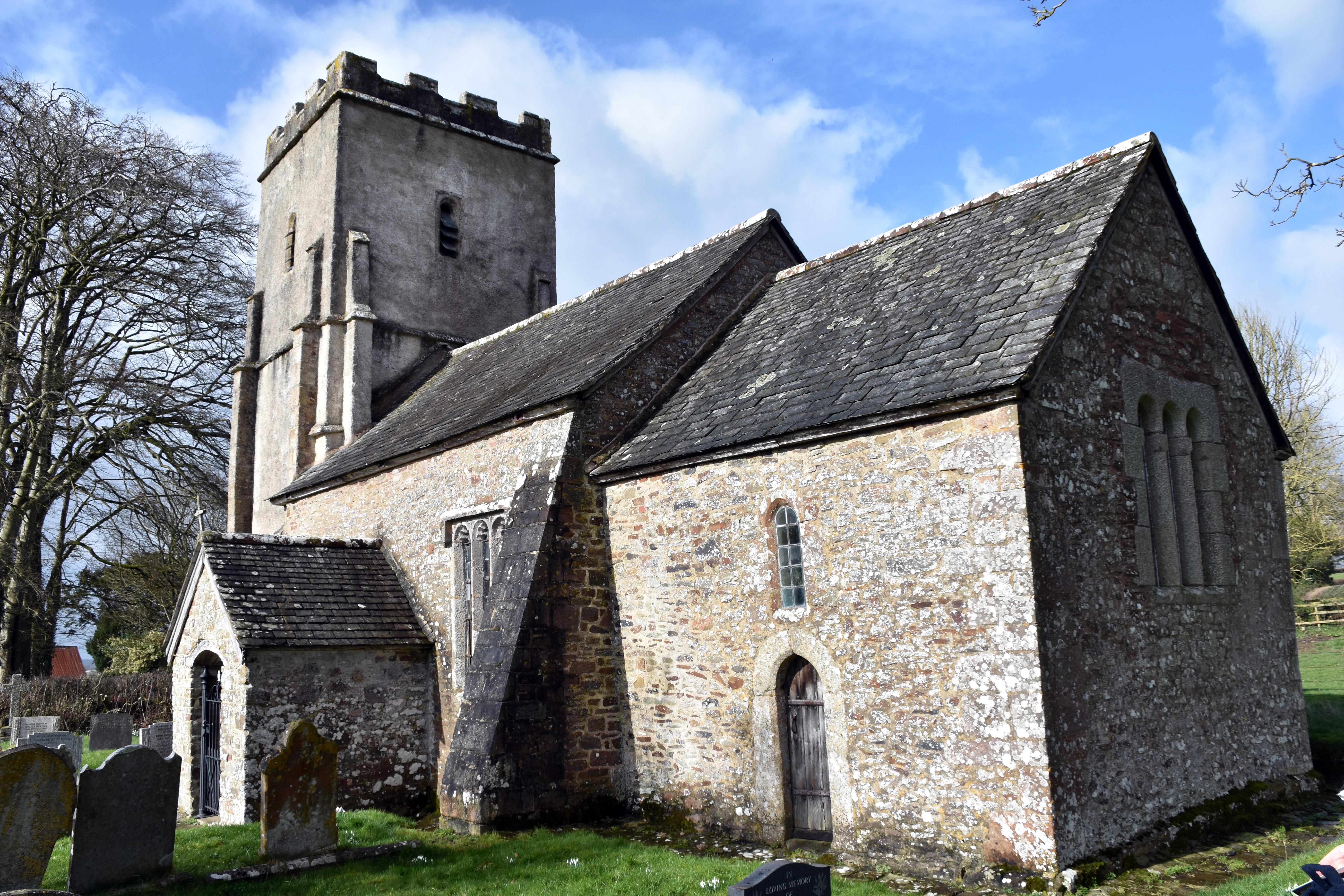
St Mary’s, Honeychurch is one of the most complete small Norman churches in Devon, and one of the few that has reached the twenty‑first century with its scale, plan, and character essentially intact. The parish itself is tiny — only 607 acres — and was almost certainly carved out of the north‑western corner of Sampford Courtenay when a landowner named Huna founded his church in the tenth century. The name “Honeychurch” preserves that origin: Huna’s Church. The ecclesiastical parish appears to represent his original estate, endowed with the tithes of the surrounding land.
The Domesday Book gives a remarkably clear picture of the settlement in 1086. The manor had belonged to Alwin Black in Edward the Confessor’s time, passing after the Conquest to Baldwin the Sheriff, though held in practice by a tenant named Walter. The five farms listed then — the demesne farm and four villein holdings — still correspond closely to Middleton, Westacott, Slade, Bude, and East Town today. Middleton, immediately west of the church, was the demesne farm, and its proximity explains why the church stands where it does: the lord of the manor built his church next to his own household.
The present building dates from the mid‑twelfth century, when Huna’s original church was replaced entirely by the small stone structure that survives. At first glance it looks like a modest perpendicular church, but the core is unmistakably Norman: a simple nave and chancel, built of small uncoursed rubble. The south chancel window, with its deep splay, and a round‑headed opening in the north wall of the nave both betray its twelfth‑century origins. Two twelfth‑century corbels now flank the south door, and the sculptured tub font — an unusual and rather striking piece — is also mid‑twelfth century, almost certainly marking the completion of the stone rebuilding.
In the later fifteenth century the church was partially reconstructed. The chancel arch was rebuilt, several Norman windows were altered or replaced, and the nave received a new roof with carved ribs, bosses, and wall plates, later ceiled over. An episcopal register entry of 1466 refers to “St Mary of Honeychurch,” confirming the church’s active life at that time. The small western tower was added in this period and still contains three bells: two probably contemporary with the tower, and a treble dated to the reign of Mary I.
The external masonry of the nave and chancel remains the original twelfth‑century work, in contrast to the coursed stone of the perpendicular tower. The church was re‑seated in the fifteenth century — or perhaps given seats for the first time — and these medieval benches survive almost untouched. Some have roughly carved ends, but most are plain oak. The box pews on the south side of the nave are eighteenth‑century additions, simple and functional.
The south porch was added last, probably in the early sixteenth century. Inside, several fittings deserve attention. The pulpit is likely Elizabethan or early seventeenth century, as is the font cover. The altar rails are straightforward country carpentry of the seventeenth or eighteenth century. On the north wall of the nave are the remains of a large painted Royal Arms of Elizabeth I. When Stabb visited in the early twentieth century he could still read part of the inscription: “Elizabeth Regina … God Save The Church, Our Queen And Nation.” In a parish this small, and so close to Sampford Courtenay, the choice to display such a prominent royal emblem so soon after the Prayer Book Rebellion is unlikely to have been accidental.
The east window of the chancel had been replaced more than once and was in poor condition by the mid‑twentieth century. In 1958 it was redesigned by Colonel Shore, using the original granite sill, as part of a conservative restoration that avoided the heavy‑handed interventions seen in many Victorian projects. Honeychurch’s survival owes much to the fact that it never had a resident squire with money to spend on “improvements.” In this case, poverty was architectural salvation.
A curious feature of the church is the collection of medieval cooking pots now displayed in a glass case in the nave. These were discovered in 1914 when the priest’s door in the chancel — long since blocked — was reopened. The pots were found inside the infill. The most likely explanation is that the blocking material came from a farmyard rubbish heap, a reminder that archaeological material often travels in unexpected ways on long‑inhabited sites.
Honeychurch has only one mural monument, to John Dunning, who died in 1773. The lack of memorials reflects the parish’s modest size and the absence of a resident gentry family. The church interior remains one of the simplest and least altered in England — a rare example of a rural Norman church that escaped both Georgian tidying and Victorian enthusiasm. It was reunited with Sampford Courtenay for civil purposes in 1894 and ecclesiastical purposes in 1927, but the building itself remains stubbornly and attractively independent.

