

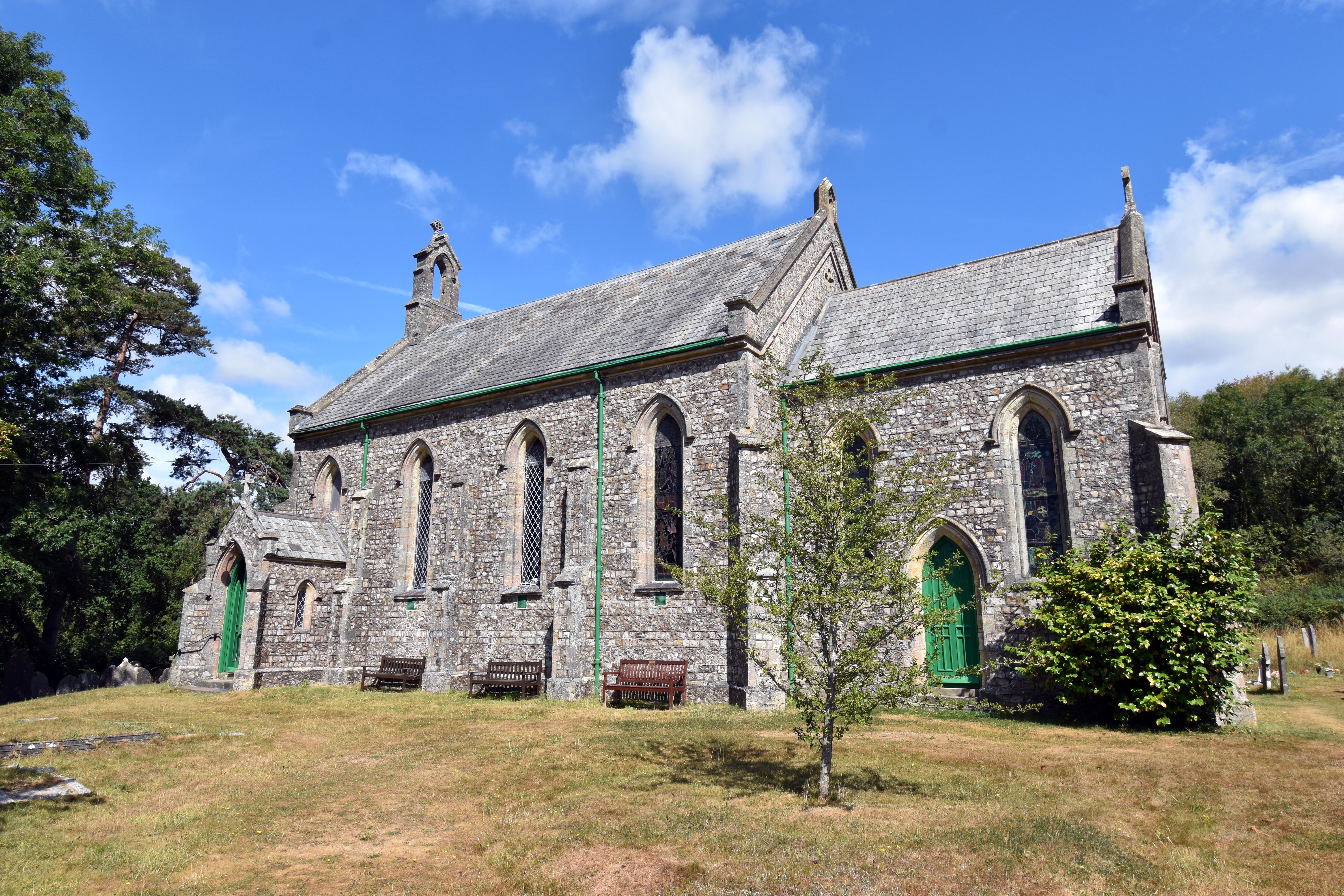
St Philip & St James was erected in 1838 as a chapel of ease for the Escot estate, commissioned by Sir John Kennaway to serve the scattered population around Fairmile. It was completed and consecrated on 1 May 1840, and in 1844 a defined ecclesiastical district was carved out of Ottery St Mary and Talaton to give the building a formal pastoral identity. The living became a vicarage in 1868, marking the point at which the chapel ceased to be merely an estate convenience and became a recognised parish centre.
The church stands alone in open fields north of Fairmile, approached by a straight lane that emphasises its isolation. It is constructed in local stone in a restrained Early English revival style, with plain lancet windows, minimal buttressing, and no tower. The absence of architectural display reflects its original purpose as a small estate church built for function rather than show.
The plan is straightforward: a short nave leading to a chancel without aisles or transepts. The chancel is rib‑vaulted, with carved corbels supporting the ribs and leaf bosses at the intersections, providing the main architectural interest in the interior. The reredos behind the altar incorporates Gothic pinnacles and mosaic panels with Christian symbols, adding limited colour and texture to an otherwise plain space.
The nave retains its original box pews, a typical early nineteenth‑century arrangement that reflects the social structure of the period, with seating allocated by family and status. Lighting is provided by simple lancet windows, and there is no extensive stained glass scheme. The fittings and woodwork are functional rather than decorative, consistent with the building’s modest ambitions.
Monuments within the church include memorials to Richard and John Kennaway, who died in 1833 and 1836 respectively, linking the building directly to the estate family that commissioned and endowed it. These memorials underline the church’s role as an estate foundation rather than a traditional medieval parish church.
St Philip & St James remains a clear example of a nineteenth‑century estate church: erected in 1838, consecrated in 1840, architecturally modest, and closely tied to the Escot estate and the Kennaway family. Its isolated setting, simple Gothic revival design, and plain interior all reflect the practical, rural context in which it was built.

