

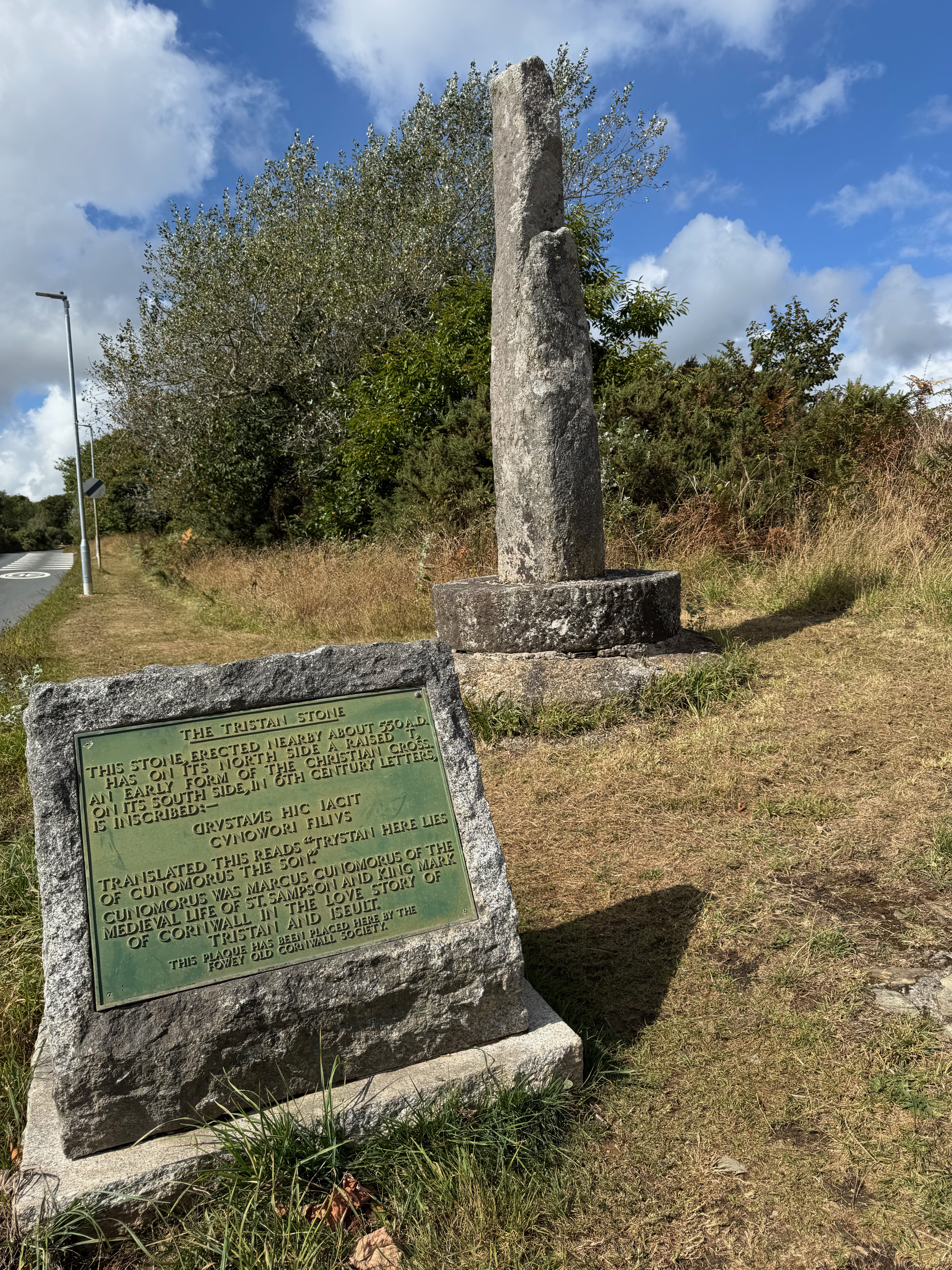
The Tristan Stone stands today beside the A3082 on the road into Fowey, a tall granite shaft rising from a modern circular base. It looks, at first glance, like any other wayside cross in Cornwall. But this 2.67‑metre monolith is far older than the medieval crosses that dot the landscape. It began its life as an early Christian memorial stone, one of a distinctive class of inscribed markers erected across the Celtic west between the fifth and eleventh centuries. These stones were simple, upright slabs set beside ancient trackways, bearing the names of individuals in Latin and often noting their family relationships. Their inscriptions usually run vertically down the face of the stone, cut in Romanised capitals or early medieval miniscules. Many include the formula “hic iacit” — “here lies” — a phrase that appears on the Tristan Stone as clearly as the day it was carved.
Early Christian memorial stones are rare outside the Celtic regions. Of the fifty‑six known examples in England, thirty‑seven are in Cornwall, where the survival of late Roman and early medieval traditions was strongest. They are important not only as some of the earliest written records in the region, but also as evidence of how Christianity took root in the centuries after Rome’s withdrawal. The Tristan Stone is one of the best preserved of them all. Its inscription — DRVSTANVS HIC IACIT CVNOMORI FILIVS — runs in two neat lines down the south‑west face, identifying the stone as the grave marker or cenotaph of a man named Drustanus, son of Cunomorus. On the opposite face is a relief Tau cross, an early Christian symbol. The mortice cut into the top of the stone shows that it was later adapted into a wayside cross, a reminder of how these ancient markers were reused as Christianity evolved.
The stone has not always stood in its present position. For centuries it was known locally as the Longstone and stood near an old crossroads closer to Castle Dore. Antiquaries from the sixteenth century onwards record it being moved several times, though always along the same ancient route. Its current location beside the A3082 preserves that continuity: it still marks the line of a very old trackway running between Fowey and the uplands to the north. The fact that it has remained a route‑marker for well over a millennium is part of its significance. Many early Christian stones were placed beside important paths, echoing late Roman funerary customs in which memorials lined the roads leading to a family’s estate. Local tradition holds that the Tristan Stone originally stood even nearer to Castle Dore, perhaps marking the approach to a royal settlement.
It is the inscription, however, that has made the Tristan Stone famous. Drustanus is the Latinised form of the Brythonic name Drystan or Tristan. Cunomorus — literally “Hound‑of‑the‑Sea” — is a name associated in later sources with a powerful sixth‑century ruler. Medieval writers sometimes give King Mark of Cornwall the Latin name Marcus Cunomorus, and a ninth‑century Breton life of St Paul Aurelian explicitly equates a Cornish king called Marcus with a figure named Quonomorius. The pairing of Drustanus and Cunomorus on a single stone, in precisely the landscape where the Tristan and Iseult story is set, has long suggested that the legend may have grown from memories of real people.
If taken at face value, the inscription implies that Tristan was not Mark’s nephew, as the medieval romances insist, but his son. That would place the origins of the tale not in the courtly world of twelfth‑century poets but in the politics of post‑Roman Cornwall, where dynastic rivalries and shifting alliances shaped the lives of local rulers. A sixth‑century prince named Drustanus, commemorated with a high‑status memorial stone near his family’s stronghold, fits comfortably within that world. The Tau cross on the stone shows that he was buried within a Christian tradition, and the quality of the lettering suggests a community with access to literacy and clerical influence — perhaps the same monastic networks that later preserved stories of St Sampson and St Paul Aurelian along the Fowey valley.
Whether this Drustanus was the Tristan of legend can never be proved. But the coincidence of name, place and period is striking. The stone stands within a mile or two of Castle Dore, long associated with King Mark. It lies on the same ridge that Béroul’s twelfth‑century romance places at the heart of the story. And it is one of the very few early medieval inscriptions in Britain to record both a personal name and a paternal relationship in a form recognisable from later tradition. Even if the romance is a heavily embroidered version of older tales, the Tristan Stone shows that a Tristan and a Cunomorus were remembered here in the early medieval period — and that their memory was important enough to be carved in stone.
Today the Tristan Stone is a Scheduled Monument and listed Grade II*. Its inscription is still clear, the Tau cross still visible, and it continues to stand beside the old route it once marked. It is one of the best‑preserved early Christian memorial stones in Cornwall, and its survival helps explain why the link between Drustanus, Cunomorus and the later Tristan story has endured. For anyone passing between Castle Dore and Fowey, it offers a straightforward reminder that some of the most famous legends have roots in real people and real landscapes.


