

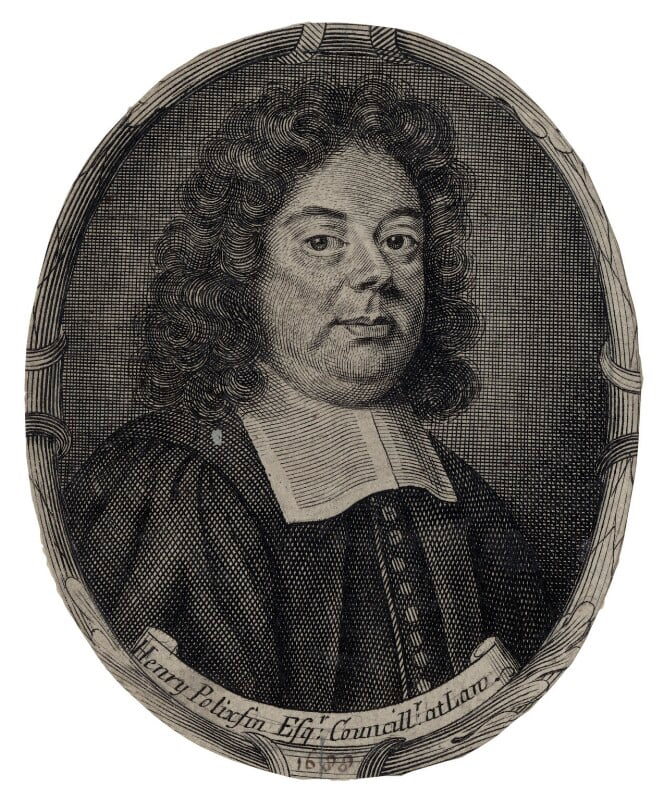
Sir Henry Pollexfen’s memorial in St Swithun’s may be modest, but the man it commemorates stood at the centre of two of the most turbulent episodes of the late seventeenth century: the brutal aftermath of the Monmouth Rebellion in 1685 and the constitutional crisis of 1688 that reshaped the monarchy. His life is a reminder that even a quiet Devon parish can be linked directly to the great turning points of national history.
When the Duke of Monmouth landed in the Westcountry in 1685, raising rebellion against his uncle King James II, Devon and Somerset became the heart of the conflict. After Monmouth’s defeat at Sedgemoor, the government responded with the notorious Bloody Assizes under Judge Jeffreys. Although Pollexfen was not one of the travelling judges, he was involved in the legal processes that followed the uprising. His role was that of a senior barrister helping to uphold the King’s authority at a moment when the Crown was determined to make an example of the rebels. It is one of the ironies of his career that a man who helped enforce James II’s will in 1685 would, only three years later, become one of the key legal minds who justified the King’s removal.
By 1688, James II had alienated much of the political nation. His attempts to promote Catholic officers, suspend laws by royal prerogative, and impose his Declaration of Indulgence on the clergy created a constitutional crisis. When seven bishops refused to read the Declaration, they were arrested and charged with seditious libel. Pollexfen was one of their defenders. The trial electrified the country, and the bishops’ acquittal was greeted with celebrations from London to the Westcountry. It marked the moment when James’s authority visibly cracked.
When William of Orange landed at Brixham in November 1688, he sought legal advice from men he trusted, and Pollexfen was among the first consulted. The central question was unprecedented: what was the legal status of a king who had fled the kingdom? Could Parliament declare the throne vacant? Could a new monarch be invited to rule? Pollexfen offered the argument that became the cornerstone of the Glorious Revolution: that James had effectively abdicated by fleeing, thereby leaving the throne vacant. This interpretation avoided the dangerous precedent of deposing a monarch while providing a constitutional pathway for William and Mary to rule jointly.
Pollexfen’s influence continued into the Convention Parliament of 1689, which formalised the new settlement. He later became Chief Justice of Common Pleas, placing him at the heart of the legal and political world during the early years of the new regime. Yet despite his national prominence, he remained firmly connected to Devon. His family’s later marriage links to the Drakes of Buckland-in-the-Moor further anchored him in the county’s history.
That such a consequential figure lies quietly beneath the carpeted floor of St Swithun’s is one of the delights of exploring Woodbury. His story sits alongside those of merchants, naval officers, colonial administrators and medical pioneers — all threads in the rich tapestry of this East Devon parish. Sir Henry Pollexfen’s life reminds us that the great constitutional shifts of the seventeenth century were shaped not only by kings and generals, but by lawyers from places like Woodbury whose arguments helped define the monarchy we know today.
The accompanying portrait of Sir Henry Pollexfen, supplied by the National Portrait Gallery, can be viewed at the following link:
https://www.npg.org.uk/collections/search/portrait/mw13303/Sir-Henry-Pollexfen

