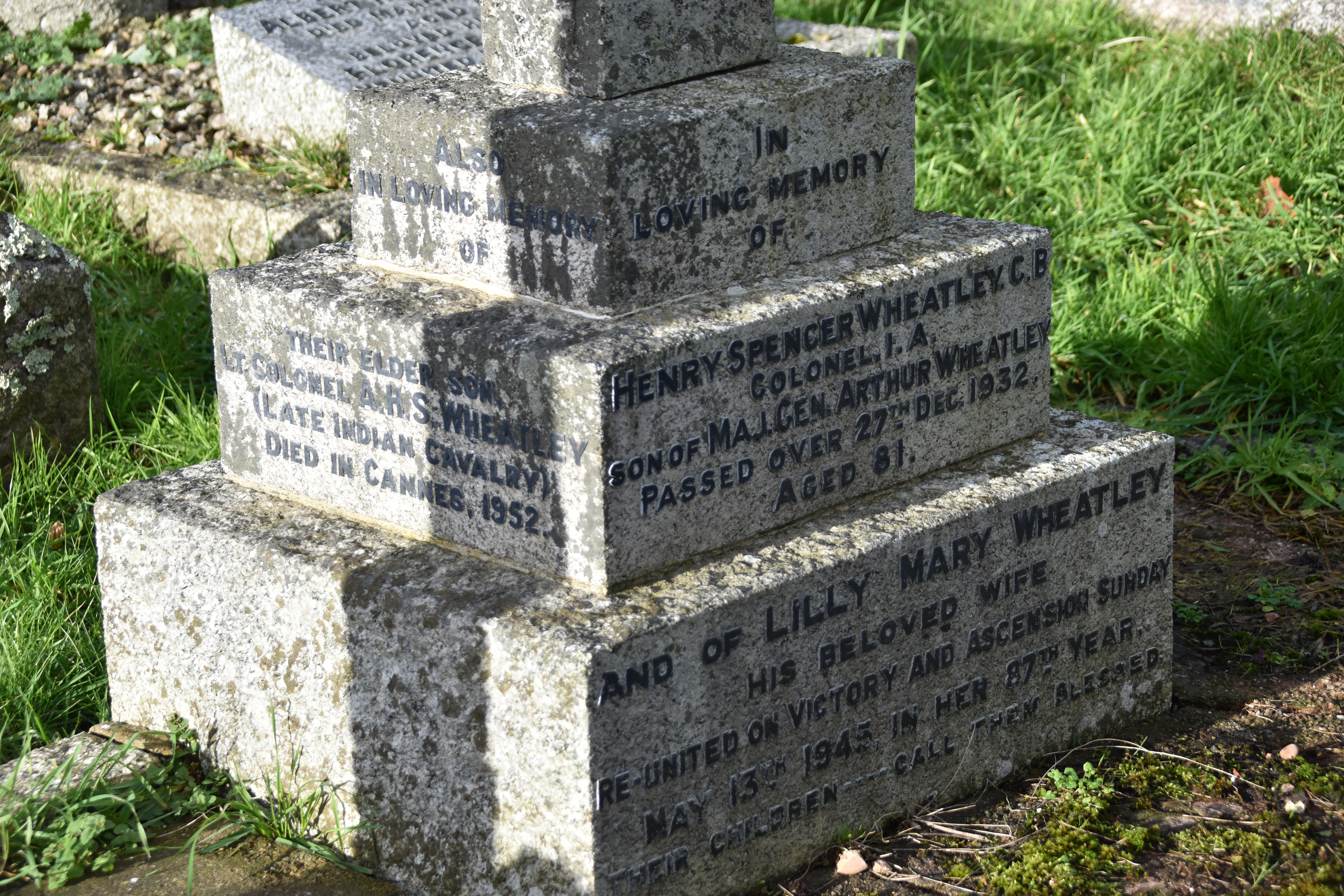
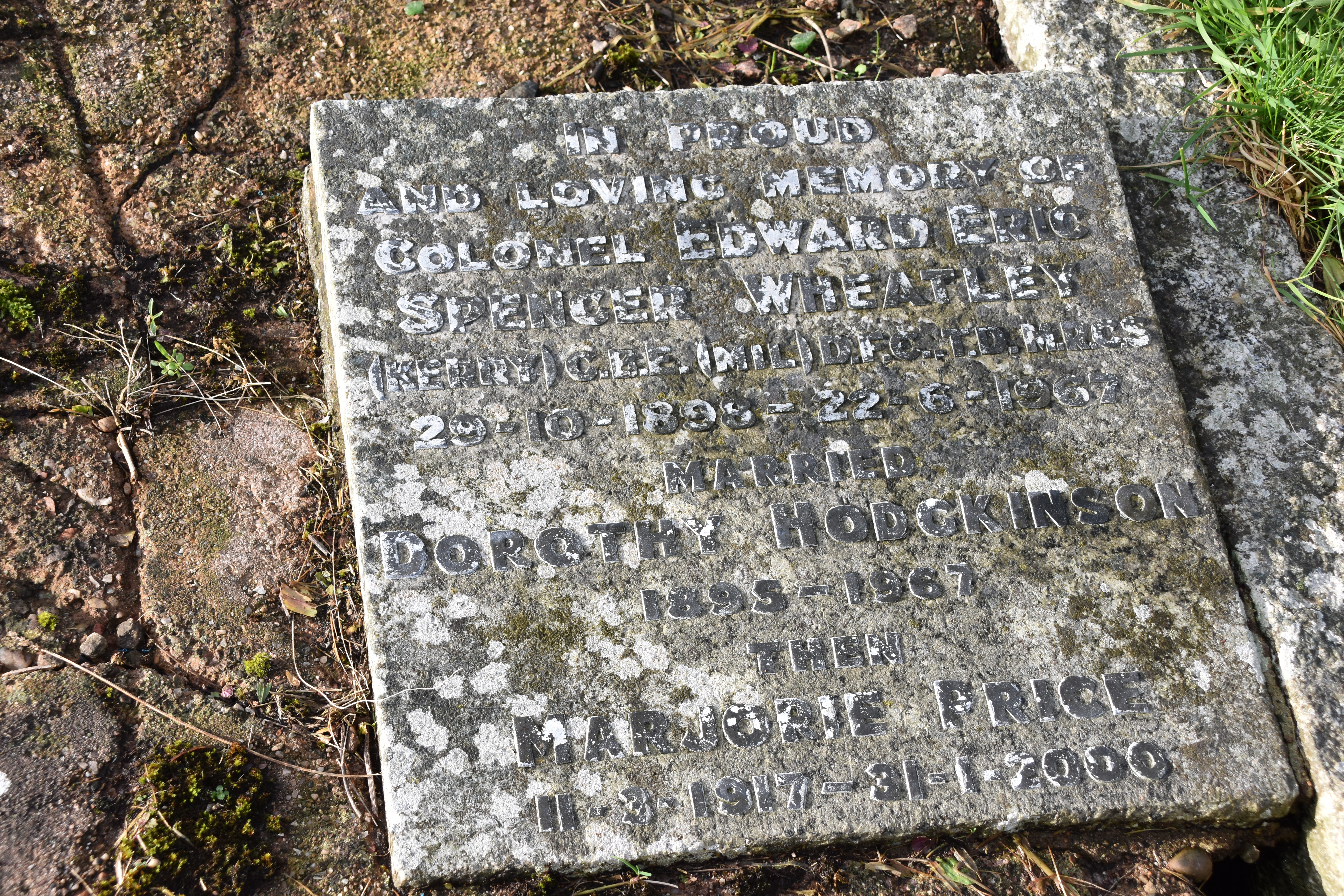
Tucked away in the churchyard of St Swithun’s lies one of Woodbury’s most quietly distinguished graves: that of the Wheatley family, whose story begins not in Devon at all, but thousands of miles away on the plains of Bengal. Their headstone is modest, but the lives it represents span the British Indian Army, the Royal Flying Corps, the North Russia campaign, the North African landings of 1942, and finally the peaceful lanes of Woodbury.
The family’s patriarch, Colonel Henry Spencer Wheatley, C.B., served for many years with the Bengal Cavalry, one of the most storied arms of the old Indian Army. His career placed him at the heart of the Raj’s military establishment, and all four of his children were born in Bengal: Mary Esme in 1883, Arthur in 1886, Dorothy in 1892, and the youngest, Edward Eric Spencer Wheatley, in 1898. Like many Anglo‑Indian families of the period, the Wheatleys lived a life that moved between cantonments, hill stations, and long sea voyages back to Britain for schooling.
By 1911, Henry had retired from Indian service and settled at The Knoll in Farnham before moving to Springhayes in Woodbury, where he lived out his final years. His daughter Mary married into the Masefield family and remained at Springhayes until her death in 1955. The Wheatleys became part of the fabric of the parish, their Indian past folded quietly into village life.
It is the story of Colonel Edward Eric Spencer Wheatley, C.B.E., D.F.C., T.D., M.R.C.S., L.R.C.P. — “Kerry” to his family — that gives the grave its remarkable depth. Born in Bengal and educated at Wellington College and the Royal Military Academy, Woolwich, he was commissioned into the Royal Garrison Artillery in 1916 before transferring to the Royal Flying Corps. He served as an observer in France and Salonika, where he was shot down and suffered a leg injury that would trouble him for the rest of his life.
In 1919 he was awarded the Distinguished Flying Cross for low‑level artillery observation during the North Russia campaign — one of the most unusual and hazardous operations undertaken by British forces after the Armistice. When the fledgling RAF shed its wartime officers, Wheatley returned to India, serving with a mountain battery and even boxing for the Army despite chronic osteomyelitis in his injured leg. He later transferred to the Royal Army Pay Corps, but ill‑health forced him to leave the service in 1932.
Undeterred, he retrained as a doctor at St Thomas’s Hospital and rejoined the Army in 1938 as a medical officer. During the Second World War he raised and commanded the 11th Motor Ambulance Convoy, served in France in 1939–40, and later commanded the 69th British General Hospital during the Allied landings in North Africa. When the ship carrying all the hospital’s equipment was sunk off Bougie, Wheatley improvised a functioning medical facility from nothing — an act of leadership that earned him the C.B.E. in 1943.
After the war, the long‑standing injury to his leg finally required amputation. Wheatley then devoted the rest of his life to the Ministry of Pensions Artificial Limb Service at Roehampton, helping other amputees rebuild their lives with a compassion shaped by his own experience. He died in 1967, having lived a life that spanned the last years of the Raj, two world wars, the birth of military aviation, and the transformation of military medicine.
The Wheatley grave in St Swithun’s is therefore far more than a family plot. It is a link between Woodbury and the cavalry regiments of Bengal; between the quiet Devon lanes and the airfields of Salonika, the snows of North Russia, and the beaches of Algeria. It is a reminder of how many imperial and military stories end not in the places where they began, but in the peaceful churchyards of villages like Woodbury.