

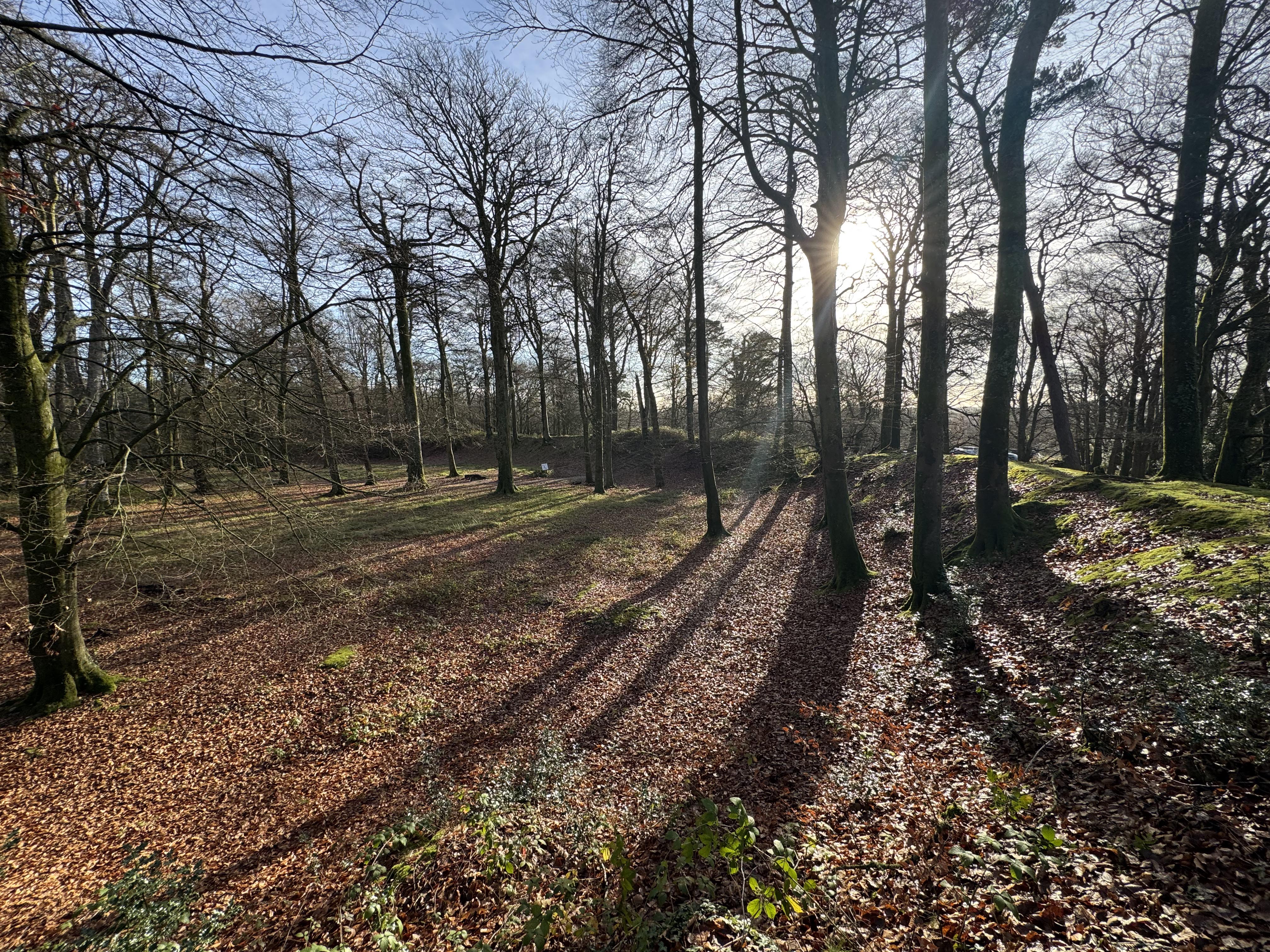
Woodbury Castle is one of those wonderfully misleading names that Devon specialises in. There is, of course, no castle at all – no battlements, no keep, no medieval masonry – just the vast, sweeping earthworks of an Iron Age hillfort perched high on the Pebblebed Heaths. Yet when you stand on its ramparts, 175 metres above the Exe Estuary with the wind coming in off the Common, you immediately understand why later generations reached for the word “castle.” The scale alone demands it.
The fort occupies a long north–south ridge, its position chosen with the sort of strategic eye that would impress any modern military engineer. From up here you command the approaches from the estuary, the lowland heath, and the ancient trackways that once threaded across this landscape. And although the site predates Norman stonework by well over a millennium, the sheer presence of its earthworks gives it a grandeur that no medieval builder would have sniffed at.
Archaeology places the origins of Woodbury Castle in the Early Iron Age, somewhere around the fifth or fourth centuries BCE. The first incarnation seems to have been quite modest – a simple palisaded enclosure of timber posts. But at some point ambition took hold, and the community expanded it into a full multivallate hillfort: a pair of concentric ramparts and ditches enclosing roughly two hectares. The inner rampart was the serious defensive line, probably topped with a timber breastwork. The outer one may have been more about controlling access or marking territory than repelling attackers.
When engineers widened the B3180 in 1971, they sliced through the ramparts and revealed just how sophisticated Iron Age construction could be. The rampart wasn’t simply a heap of earth but a carefully engineered glacis – layers of tamped soil and stone angled for stability. The modern road now runs straight through the original north and south entrances, which may once have had timber-lined gateways and double doors. One can almost imagine the creak of those gates opening to admit traders, herders, or perhaps a visiting chieftain.
For all its imposing appearance, Woodbury Castle was never a bustling settlement. Excavations have found traces of roundhouses and, intriguingly, a raised granary built on six stout posts to keep grain dry and out of reach of vermin. But there is no sign of continuous occupation. Instead, the fort seems to have been used intermittently – perhaps as a refuge in troubled times, a gathering place for the local tribe, or a symbol of authority visible for miles around. The surrounding fields would have grown spelt wheat and barley, ground on saddle querns whose worn stones still turn up across the heath.
The story stretches back far beyond the Iron Age. Flint tools scattered across the Common show that Mesolithic hunters were here thousands of years earlier. Neolithic and Bronze Age communities shaped the heath through grazing and controlled burning, and the barrow cemeteries nearby – such as those at Queen’s Drive – hint at ritual continuity and a long-standing reverence for this ridge. By the time the hillfort was built, the area was already a landscape of memory, resource, and significance.
Today Woodbury Castle is a Scheduled Monument, cared for by the Pebblebed Heaths Conservation Trust and Clinton Devon Estates. A major restoration in 2018 stabilised the ramparts and improved paths, though the fort remains wonderfully open and atmospheric. Interpretation panels help visitors make sense of what they’re seeing, but nothing quite prepares you for the moment you step onto the rampart and realise you’re standing on a structure engineered two and a half thousand years ago – and still doing its job.
It is one of those places where the past feels very close. A walk around the ramparts is not just a stroll through an Iron Age fort, but a circuit of four millennia of human presence on this remarkable ridge above the Exe.

