

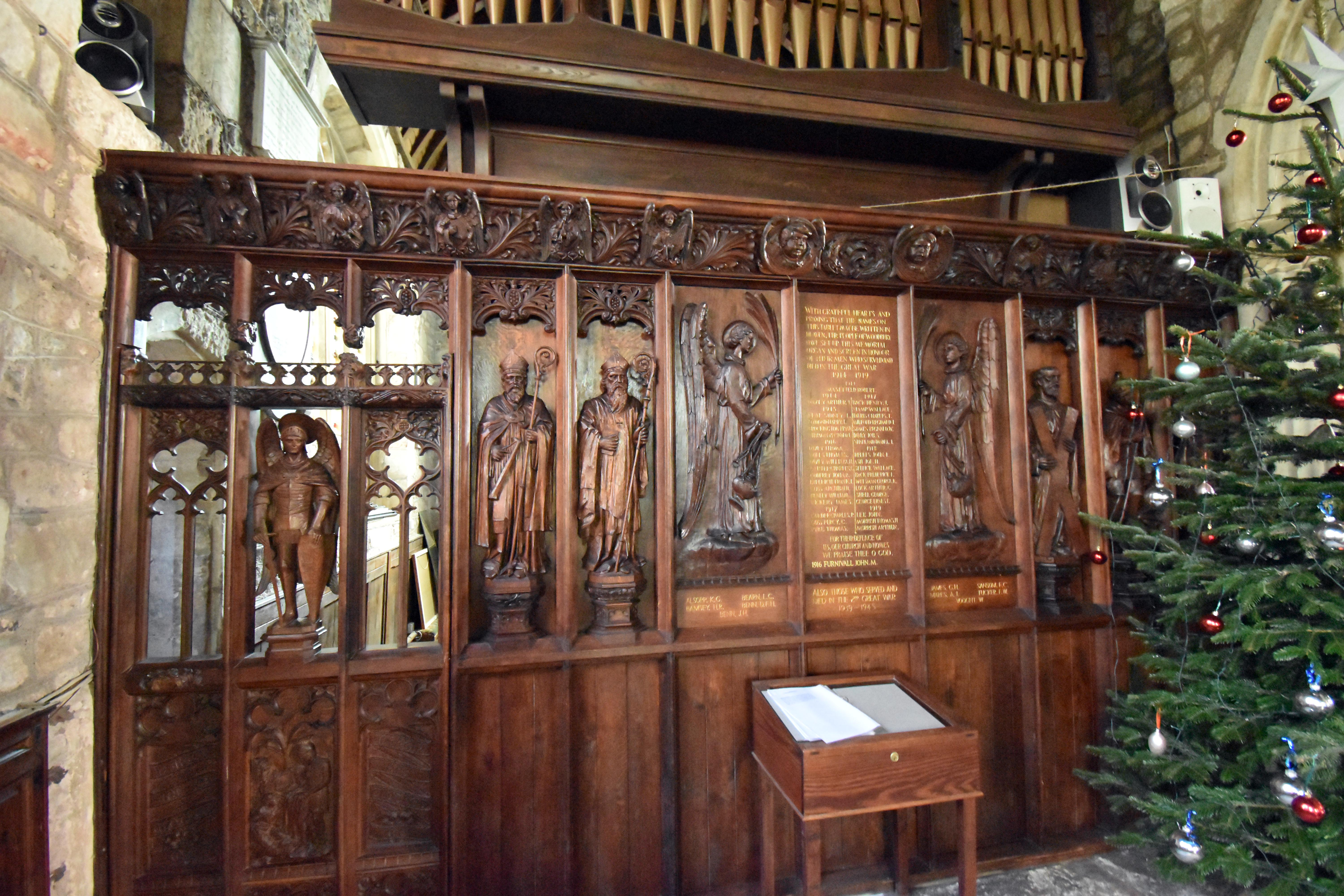
The war memorial at St Swithun’s Church is one of those places where the past feels unusually close. The names carved into the stone are familiar Woodbury surnames, yet the stories behind them stretch far beyond the parish boundary. They speak of young men who left farms, workshops and cottages in the village and found themselves in the trenches of Flanders, the deserts of Palestine, the hospitals of India and the training grounds of Canada. What follows is a cross‑section of those lives, drawn from the memorials and records preserved in the church.
One of the most striking stories is that of Major Robert Masefield of the King’s Shropshire Light Infantry. Born in New Zealand but raised in Woodbury by his uncle, he had already served in Ireland, Hong Kong, India and South Africa before the First World War began. Recalled from leave in 1914, he was killed by shrapnel near Armentières while commanding his company. His men remembered him with extraordinary affection, describing him as a “most gallant gentleman” whose presence alone seemed to steady the regiment. His memorial in St Swithun’s links the quiet Devon village to the very first months of the war.
Another Woodbury-born soldier, Private Harold Joe Ash, took a very different path. Orphaned young, he emigrated to Canada and enlisted in the 8th Battalion Canadian Infantry. He was killed on the first day of the Battle of Amiens in 1918, a decisive moment in the final Allied advance. With no known grave, his name is inscribed on the Vimy Memorial alongside thousands of other Canadians who fell in France. His journey from a Woodbury childhood to the Canadian Expeditionary Force is a reminder of how global the war truly was.
The Auton family suffered multiple losses. Private Charles James Auton of the Coldstream Guards was killed at Ypres in October 1914, just days after arriving in France. His cousin, Private Josiah Henry Auton of the Devonshire Regiment, died of wounds on the Somme in 1916. Their stories reflect the brutal attrition of the Western Front and the close-knit nature of village life, where several members of the same extended family often served—and fell—within months of each other.
The Back family endured similar tragedy. Private Henry John Back of the Somerset Light Infantry was killed in the Arras offensive in 1917 and has no known grave. His younger brother, Private Frederick Back of the Hampshire Regiment, died in Flanders in 1918 at just eighteen years old. Their parents, living in Ebford and later Cottles Lane, lost two sons in the space of a year—a grief repeated in many households across the parish.
Some men died far from the Western Front. Sergeant Charles Philip Carder of the Devonshire Regiment was killed in the Salonika campaign in 1917, one of the lesser-known theatres of the war. His body was never recovered, and he is commemorated on the Doiran Memorial. His widow Martha was from Woodbury, and his story adds a Balkan chapter to the village’s wartime history.
The Davey family lost several members across different branches. Private Arthur Davey, just eighteen, was killed in 1915. His cousin, Private Job Searle Davey, died in the mud of Passchendaele in 1917. Private Thomas George Davey of the Royal Army Medical Corps died in Le Havre in 1916, while Private William Henry Davey was killed on the first day of the Somme. Their grandmother Thirza, a lacemaker living on Globe Hill, raised several of them—only to see them lost one by one to the war.
Private Ernest George, a grocer’s assistant from Woodbury, died in a German prisoner-of-war hospital in November 1918. Captured during a gas attack, he may have succumbed to influenza, which swept through Europe in the final months of the war. His grave lies in Niederzwehren Cemetery, one of the central burial grounds for Allied prisoners. His story is a reminder that many died not in battle but in captivity, far from home.
Private Charles Carter of the Devonshire Regiment was killed on the first day of the Somme, 1 July 1916. His body was never recovered, and he is commemorated on the Thiepval Memorial. His father, a carpenter, took his own life a decade later—a tragic postscript to the family’s wartime loss and a stark reminder of the long shadows cast by the conflict.
Private John Mainwaring Furnivall of the Dorsetshire Regiment died at Leuze Wood in September 1916. Born in Woodbury, the son of a local surgeon, he is commemorated not in his home parish but in Hutton, Somerset, where his father had family ties. His absence from the Woodbury memorial is itself a poignant reminder that commemoration often followed family decisions rather than geography.
Private Henry Dymond of the Devonshire Regiment died of wounds in 1915 and is buried in Poperinghe Old Military Cemetery. His mother Lydia lost three sons to the war: Frank Brockington in May 1915, Henry in August 1915, and Alexander George Dymond in 1921, likely from the lingering effects of his service. Few families in the parish bore a heavier burden.
Driver Percy George of the Royal Horse Artillery died of wounds in 1917 and is commemorated on the Arras Memorial. His brother, Gunner Archibald Goss, died in India in 1916 while serving with the Royal Field Artillery. Their service spanned continents, from the Western Front to the cantonments of Lucknow, reflecting the global reach of the British Army.
Private John (Jack) Lee of the Tank Regiment died in February 1919 at Etaples, a vast hospital complex behind the Western Front. He may have died from illness rather than wounds, a reminder that the war’s toll continued long after the armistice. His widow Florence received a small gratuity, and his name stands among those who died in the uneasy months of transition from war to peace.
Private Daniel Shapland of the Devonshire Regiment was killed in December 1917 during the final push toward Jerusalem. Born in Mariansleigh and living at Coombe Farm, he died in fierce fighting just days before the city fell. His name is inscribed on the Jerusalem Memorial, linking Woodbury to the long and complex campaign in Palestine.
Lance Corporal George Arthur Shell of the Worcestershire Regiment died of wounds in October 1918, only days before the war ended. He was nineteen. His grave in Delsaux Farm Cemetery marks the resting place of a young man who came heartbreakingly close to surviving the conflict.
These stories, drawn from the memorials and records of St Swithun’s, reveal a parish deeply touched by global events. The men commemorated here served in every major theatre of the First World War, and their families bore the consequences for decades. The memorial stands as a reminder that even the quietest villages are shaped by the great currents of history.

