

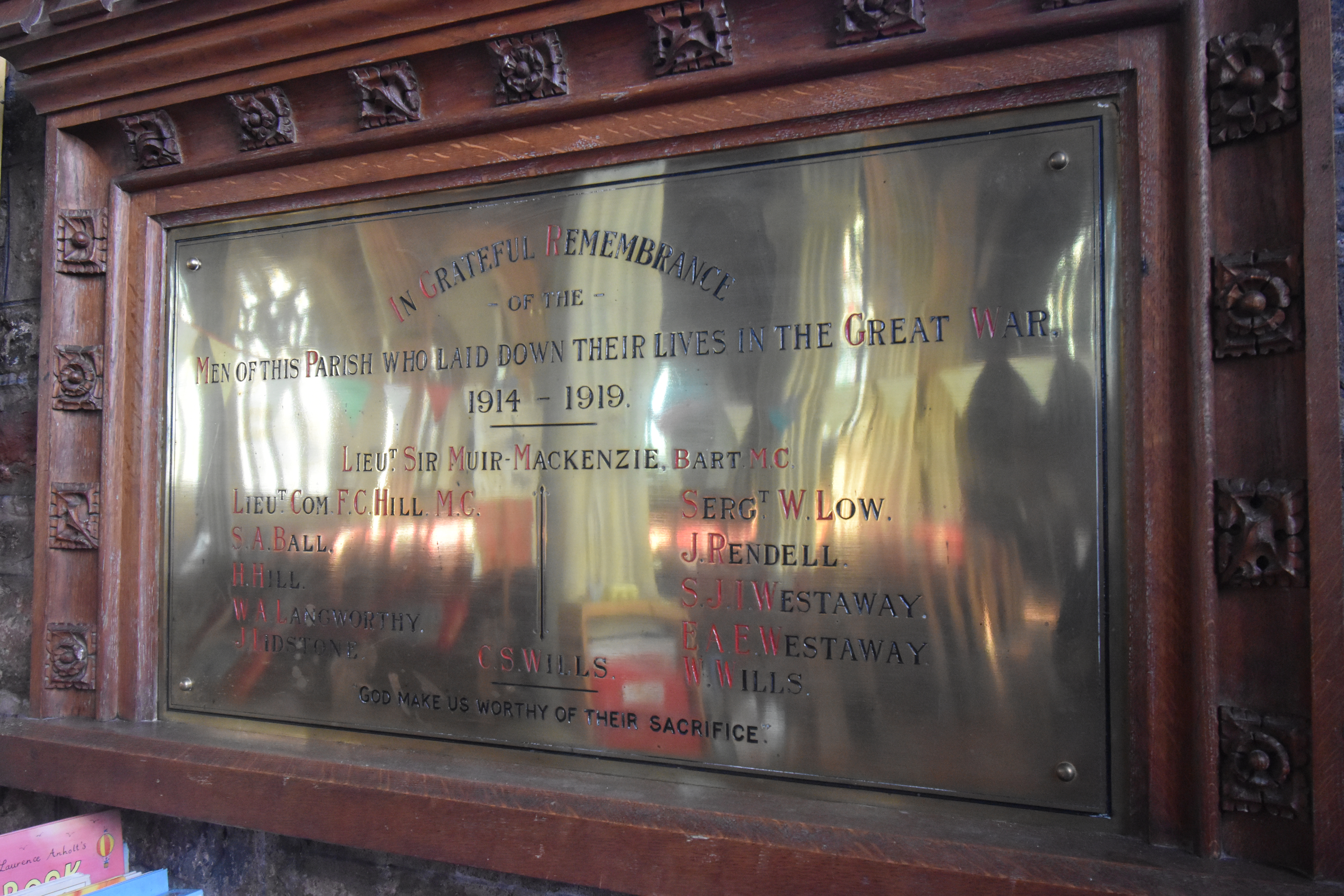
The names carved on Marldon’s war memorial form a small roll of honour, yet behind each one lies a life shaped by the rhythms of the parish and ended by the upheavals of the early twentieth century. They represent farm labourers, stokers, gunners, sailors, and officers; men who left the lanes and fields of the village for distant fronts and never returned. Their stories, pieced together from service records, parish registers, and local memory, give a sense of the breadth of experience contained within a single rural community.
It is worth comparing this list with the Marldon Roll of Honour which was completed on 25 March 1916, at a time when almost all of the men later commemorated on the village's formal war memorials were still alive. That Roll was created before the horrors of the Somme, before the Battle of Jutland, and before the later losses of Passchendaele, the German Spring Offensive and the Hundred Days Offensive. At that stage of the war many of the casualties already suffered by Britain had fallen among the professional pre-war Regular Army and Royal Navy, while most of the volunteers who had enlisted in 1914 and 1915, together with the first conscripts called up under the Military Service Act of 1916, had yet to experience the full intensity of the fighting. With the exception of William Low, who died shortly before the Roll was inscribed, many of the men recorded by "Tigray" would later lose their lives in the great battles that followed and would come to be commemorated on Marldon's post-war memorials. The Roll therefore provides a remarkable snapshot of the parish at a moment when the fate of its servicemen remained unknown, preserving a record of a community on the eve of the Somme and before the full human cost of the Great War became apparent.
Frederick Charles Hill, born in Marldon in 1882, rose to become a Lieutenant‑Commander in the Royal Naval Volunteer Reserve. Serving at HMS Excellent, the Navy’s gunnery school at Portsmouth, he was awarded the Military Cross for his wartime service. Hill survived the fighting but died of illness in August 1919 at the age of thirty‑seven, and was brought home to be buried in Marldon churchyard.
Samuel Albert Ball, a Private in the 2nd Battalion, Wiltshire Regiment, was born in Ashcombe in 1885 and later grew up in Marldon. Before the war he married Annie Ball and settled in Torquay. He was killed on 21 March 1918 at the age of thirty-three during the opening day of the German Spring Offensive, known as Operation Michael, the largest German attack on the Western Front since 1914. Like thousands of other British soldiers caught in the sudden assault, he fell during the desperate fighting that marked the beginning of the German advance.
Herbert William Elkanah Hill, a Sergeant in the 2nd Battalion, Devonshire Regiment, was born in Dartington in 1894. He died on 27 September 1918 at the age of twenty-four during the Hundred Days Offensive, the series of Allied attacks that forced the German Army into retreat and brought the First World War to its conclusion. His battalion was heavily engaged in the fighting of the final advance, which, despite its success, continued to inflict heavy casualties until the last weeks of the war.
Walter Alfred Langworthy, born in Marldon on 27 April 1893, was the son of Robert Langworthy and Elizabeth Langworthy of Galmpton, Brixham. Enlisted in the Plymouth Division of the Royal Marine Light Infantry, he served aboard HMS Snaefell, a requisitioned steamship employed on naval patrol and transport duties during the First World War. On 5 June 1918, HMS Snaefell was torpedoed and sunk in the Mediterranean by the German submarine UB-105 while sailing from Alexandria to Malta, and Langworthy was among those lost. He died at the age of twenty-five and, having no known grave, is commemorated on the Plymouth Naval Memorial.
John Lidstone, Chief Stoker aboard HMS Warrior, was born in Marldon on 5 March 1875. The son of Robert Lidstone and Ann Lidstone, he later married Boadicea Lidstone of Cornwall. He died at the Battle of Jutland on 31 May 1916 at the age of forty-one when Warrior was badly damaged during the fighting. Unable to reach port, the ship was abandoned the following day and subsequently sank while under tow. His death links the parish directly to the largest naval battle of the First World War and the only full-scale clash between the British Grand Fleet and the German High Seas Fleet.
William Low, a Sergeant in the Royal Garrison Artillery, was born at Compton, Marldon, in 1872, the eldest son of Thomas Low and Mary Low. By 1881 he was living with his family in Compton, where his father worked as a farm labourer. His later life is less clear, although he appears to have pursued a military career. He died on 21 February 1916 at Lakenham Military Hospital, Norfolk, aged forty-three, and was returned to Devon for burial in the south-west part of St John the Baptist Churchyard, Marldon, where a Commonwealth War Graves Commission headstone marks his grave. As a member of the Royal Garrison Artillery, he served in the branch of the Army responsible for operating the heavy guns and artillery that dominated the battlefields of the First World War.
James Rendell was born around 1893, the son of James Rendell, and served as a Private in the 2nd Royal Marine Battalion of the Royal Naval Division, Royal Marine Light Infantry, with the service number PLY/15464. He was killed on 13 November 1916 at the age of twenty-three and is buried in Y Ravine Cemetery, Beaumont-Hamel, on the Somme. His death came on the opening day of the Battle of the Ancre, the final great offensive of the Somme campaign. The Royal Naval Division attacked the heavily fortified German positions around Beaumont-Hamel, where the deep Y Ravine formed one of the strongest defensive features on the battlefield. After months of bitter fighting, the objective was to capture Beaumont-Hamel and secure ground that had resisted repeated attacks since July. Despite snow, mud and fierce resistance, the assault succeeded in taking the village, though at considerable cost. Writing afterwards of the battle, the Royal Naval Division's historian recorded that Beaumont-Hamel was "the most completely successful operation carried out by any division on the Somme", a success won through determination and sacrifice. It was during this hard-fought action that James Rendell lost his life, one of the many Royal Marines who fell in the division's costly victory.
Stanley James Isaiah Westaway, a Stoker 1st Class serving at HMS Vivid, was born in Marldon in 1898, the son of George Westaway and Eliza Westaway. HMS Vivid was the Royal Navy's shore establishment and training depot at Devonport, where stokers were trained and administered for service in the fleet. Stanley died on 8 April 1918 at the age of nineteen and is buried in St John the Baptist Churchyard, Marldon. His death came during the final year of the First World War, only six months before the Armistice. He was the brother of Ernest Albert Edward Westaway,
Ernest Albert Edward Westaway, born in Marldon in 1887, was the son of George Westaway and the late Eliza Westaway. He served initially with the Devonshire Regiment before transferring to the 21st Battalion, Machine Gun Corps. By the final year of the war the Machine Gun Corps formed a vital part of the British Army's firepower, providing sustained support for infantry attacks and defensive operations. Ernest was married to Lily Westaway of Upton, Torquay, and was the father of children. He died on 8 October 1918 at the age of thirty-one and is buried in Marcoing British Cemetery, France. His death occurred during the Hundred Days Offensive, the series of Allied attacks that forced the German Army into retreat during the closing weeks of the war. Tragically, Ernest did not live to see the Armistice, dying just one month before the end of the conflict. His loss came only six months after the death of his younger brother, Stanley James Isaiah Westaway, a Stoker 1st Class in the Royal Navy, making the Westaway family one of the Marldon families to suffer the loss of more than one son during the Great War. He is also remembered on the Torquay memorial.
Charles Stanley Wills was born in Marldon in 1898, the son of Albert Edward Wills and Susan Elizabeth White. He served as a Private in the 9th (Service) Battalion, Devonshire Regiment. Sadly he was killed on 26 October 1917 at the age of nineteen. On that date the 9th Devons were involved in the infamous Passchendaele campaign. The division attacked east of Ypres, advancing along the Menin Road towards Gheluvelt. The attack was intended both to support the main Canadian assault on Passchendaele Ridge and to prevent the Germans moving troops from the Gheluvelt sector to reinforce Passchendaele. The conditions were appalling. Heavy rain had turned the battlefield into a quagmire, making movement, supply and artillery support extremely difficult. The Devonshire Regiment's history later described the battle: "October 26th, 1917, stands out as the worst day the 8th and 9th Devons ever experienced. They had known heavy losses before, at Loos, at Mametz, at Ginchy, but they had never gone into an attack with the scales weighted so heavily against them. ... It was the mud that was Gheluvelt's most effective defence, and the failure of the 8th and 9th to take Gheluvelt was recognised by those in authority as due to no fault of theirs, rather their determination and gallantry were lavishly praised ... the spirit which had led these two battalions to advance so unflinchingly to an attack they could not but realise to be a forlorn hope, represents a triumph of discipline and of esprit de corps. The saddest day in their history, it was, nevertheless, the high-water mark of their endeavour."
William Wills, born in Marldon on 14 May 1871, was the eldest son of Albert Edward Wills and Susan Elizabethike his younger brother Charles, who was killed at Passchendaele, William spent almost twenty-seven years in the Royal Navy. Enlisting in November 1892, he served as a Stoker aboard numerous vessels before and during the First World War, eventually attaining the rank of Stoker 1st Class. During the war he served through HMS Vivid, the Royal Navy's barracks, training establishment and administrative depot at Devonport. Following his discharge in August 1919, William was admitted to the Royal Naval Hospital at Great Yarmouth, where records describe him as a "Dangerous Lunatic", a reflection of the terminology and understanding of mental illness at the time - he may well have been suffering from post traumatic stress disorder. He remained there until his death on 31 January 1921 aged forty-nine.
Sir Robert Cecil Muir Mackenzie, born on 19 October 1891, was the son of Lieutenant-Colonel Sir Robert Smythe Muir Mackenzie, 4th Baronet of Delvine, and Lady Muir Mackenzie of Marldon House. Educated at Marlborough College and Jesus College, Cambridge, he served as a Lieutenant with the 5th Battalion, attached to the 9th Battalion, Durham Light Infantry, and was awarded the Military Cross for gallantry during the First World War. In February 1918 he succeeded his father as 5th Baronet of Delvine, but enjoyed the title for only a matter of weeks. On 12 April 1918, during the Battle of the Lys, part of the German Spring Offensive, he was killed in action at the age of twenty-six. At the time, battalions of the Durham Light Infantry were heavily engaged in the desperate fighting in Flanders as British forces attempted to halt the German advance towards the vital rail centre of Hazebrouck. His death came during one of the most critical periods of the war for the British Expeditionary Force and less than seven months before the Armistice. Married with a young child, he was buried in Bienvillers Military Cemetery, France, where his headstone bears the inscription: “He Leaves A White Unbroken Glory.” His loss brought the impact of the Great War directly to one of Marldon's most prominent families.


